Thursday, February 22, 2007

NAACP CELEBRATES THE LIFE OF DR. WILLIAM HENRY WADDELL IV

Source: HTTP://WWW.NAACP.ORG/NEWS/PRESS/2007-02-09/INDEX.HTML

Feb. 9, 2007

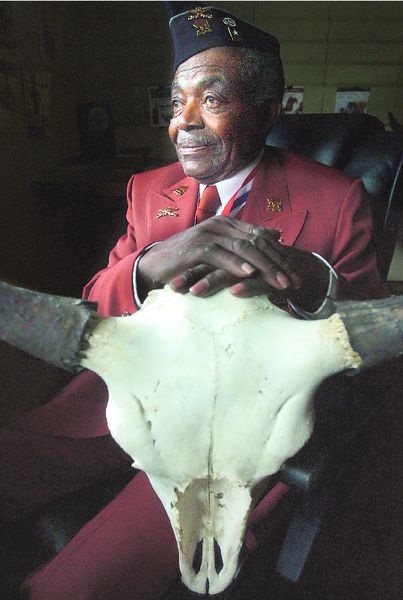
Dr. William Henry Waddell IV

The NAACP celebrates the life of Dr. William Henry Waddell IV, the nation’s second-oldest known Buffalo Soldier, a pioneer in the field of veterinary medicine and a lifetime NAACP member. He died January 30 in Hawaii at the age of 98.

A man of many “firsts,” Waddell was born in South Richmond, Va. in 1908. He studied veterinary medicine at Lincoln University and passed the Pennsylvania State Board of Veterinary Medicine in 1935, becoming the first licensed black veterinarian in the state. Waddell later co-founded the Tuskegee Institute School of Veterinary Medicine, where he served as the school’s first faculty member and worked with George Washington Carver on peanut oil therapy. Waddell was also the first black member of the American Veterinary Medicine Association and the first black veterinarian to practice in West Virginia.

From 1941 to 1946 Waddell served the U.S. 9th and 10th Cavalry Regiments of the United States Army as a Buffalo Soldier. The Buffalo Soldiers were originally established by Congress as the first peacetime all-black regiments in the United States Army, but later operated during wartime. Waddell served abroad during the Italian campaign of World War II and was later wounded in action in North Africa.
Waddell was the second oldest of two surviving Buffalo Soldiers, and the last member of the 9th and 10th Calvary Regiments. He continued to attend Buffalo Soldier reunions each year up until his death. Joe Barnes of San Francisco is said to be the oldest known and sole remaining Buffalo Soldier.

After the war, Waddell opened a veterinary clinic in Tuskegee, Ala. and continued his affiliation with Tuskegee University. He was honored for his contributions to the veterinary school in 2004.

Among his many honors, Waddell received an honorary Doctor of Science degree from Lincoln University and a lifetime achievement award at the National Veterinary Association meeting in Honolulu last year. An annual scholarship named in his honor was recently instituted by the NAACP Honolulu Branch.
Waddell is remembered as a wise and exceptionally kind man who encouraged youth to seek knowledge and education. He is survived by a host of loving relatives and family friends and will be sorely missed.

Founded in 1909, the NAACP is the nation's oldest and largest civil rights organization. Its members throughout the United States and the world are the premier advocates for civil rights in their communities, conducting voter mobilization and monitoring equal opportunity in the public and private sectors.

Wednesday, February 21, 2007

1908-2007 William Waddell, Buffalo Soldier

By Will Hoover, Advertiser Staff Writer

William Henry Waddell — one of only two surviving Buffalo Soldiers — died at age 98 Tuesday evening at his home in Ka'a'awa.

Waddell, who retired in Hawai'i in 1972 with his wife Lottie, served from 1941 through 1946 with the 9th and 10th Cavalry during the Italian campaign of World War II.

The term "Buffalo Soldier" is one of pride that harks back to the period immediately following the Civil War when depleted Union troops were, by act of Congress, strengthened for the first time to include six regiments of black soldiers.

The term became synonymous with all black regiments that served during subsequent conflicts including the Spanish American War, World War I, World War II and the Korean War, after which the unit was discontinued.

But Waddell had been a trailblazer before entering the war. In 1935, he made history by becoming the first black to be granted a license to practice veterinary medicine in Pennsylvania after he passed the State Board of Veterinary Medicine.

Waddell, who was born in South Richmond, Va., in 1908, also was the first black to practice veterinary medicine in West Virginia and the first black member of the American Veterinary Medicine Association. He was further honored in 2003 as a co-founder of the historic Tuskegee Institute School of Veterinary Medicine.

"I think he was a great humanitarian," said his daughter Kathryn Waddell Takara, a professor at the University of Hawai'i at Manoa. "He had a kind heart.

"He was a terribly hard worker who came up from nothing. He's my hero."

In 2004 ,Waddell was awarded a doctor of science honorary degree from the Lincoln University in Pennsylvania.

Through it all, Waddell remained a man of warmth and humor. His autobiography, "People are the Funniest Animals," was published in 1978. He also authored several other books.

"He was a grand, grand man," said retired UH professor Miles Jackson, a neighbor of Waddell's. "We all looked upon him as a sage. He had always had positive words of wisdom to share with people.

"He had a fantastic memory. We really enjoyed his company."

To those who knew him, he was an inspiration who will be greatly missed.

"The sad state of affairs is that we began February, Black History Month, with the loss of a national treasure," said Alphonso Braggs, president of Hawai'i NAACP.

"He's the reason that many of us are able to pursue our goals, our dreams and our aspirations. And right up to the end, he was still being that inspirational leader and mentor that he is very well known for.

"The irony is that at this time last year, Dr. Waddell was going around the Island bases with us celebrating Black History Month. So there's going to be that absence this year."

Yet, Braggs and Jackson both praised Waddell for giving those who follow in his footsteps the courage and motivation to continue to carry the message of inspiration and hope forward.
"We can only hope that we are able to live long enough to leave a legacy as great as what he's left us," Braggs said.

At a time when many young people are having trouble understanding the civil rights struggles of the '50s and '60s, he said Waddell's legacy stands as a beacon of light.

Already that legacy has grown. On Jan. 13 — less than a month before his death — the Honolulu Hawai'i branch of the NAACP awarded its first scholarship in Waddell's name, Braggs said.

"We really want to perpetuate what he has done. And that's one way to remind folks," Braggs said.

His wife preceded him in death. Aside from his daughter, survivors include two grandchildren and two great-grandchildren.

Photo from the Buffalo Soldier Research Museum
http://buffalosoldiersresearchmuseum.org/research/books/waddell.htm

This article was published on February 4, 2007

Tuesday, February 13, 2007

A New Play about the Buffalo Soldiers

Buffalo Soldiers, A Tale Lost


Please note: For tickets to the Berkeley shows at the Julia Morgan Center (Feb 15 - 17), please call the CBON Ticket Line at (925) 798 -1300. See below for other ticket information.

A powerful, eighteen hundred period theatrical release: Buffalo Soldiers, A Tale Lost triangles the lives, struggles, and conflicts of the Negro Cavalry, Army Officials, and fearless Indian Warriors, while a lone courageous soldier risks his life to convince his comrades that fighting in a war where there are no victors is wrong.

This classy, new, original production breathes life into a forgotten, but crucial chapter in American history. Through dramatic encounters and action filled plots; Buffalo Soldiers, A Tale Lost, displays a clash between three cultures... The White Officers, who are steadfast in their superiority, the Indians, who are vibrant in their refusal to sign a peace treaty, and the Negro soldiers, whose complexities range from house slave to field slave, from heroes to killers, from proud service to insubordination.

The characters in the play comprise an all-male cast that consists of sixteen different roles. Derived from actual events. It's intense, it's original, it's powerful, Buffalo Soldiers, A Tale Lost seeks to break new ground in American theatre.

Dates:
February 15, 2007 - 8:00 PM
February 16, 2007 - 8:00 PM
February 17, 2007 - 8:00 PM

Location:

Julia Morgan Center for the Arts2640 College Ave., Berkeley, CA Adults $30, Children $15, Student and Senior $25Call the CBON Ticket Line: (925) 798-1300

Dates:

February 21, 2007 - 8:00 PM Through
February 24, 2007 - 8:00 PM

Location:

Montgomery Theater 271 S. Market Street, San Jose, CA

Sunday, December 17, 2006

Breaking bread together for the Holidays

Members of the Los Angeles Chapter of the 9th & 10th (Horse) Cavalry Association, gather for their annual Buffalo Soldier informal luncheon and family get-to-gather.


Pictured above, from left to right seated, are: Trooper Robert McDaniel, World War II veteran who served with the 9th Cavalry regiment stationed at Fort Riley and for a time was a member of headquarter staff and worked for Gen. Benjamin O. Davis Sr., Trooper Alfred Evans, WWII veteran who served with the 10th Cavalry regiment, Trooper John Tull, WWII veteran who served with the 10th Cavalry regiment, Trooper Andrew Isaacs, WWII veteran with the 10th Cavalry regiment and is the newly elected President of the L.A. Chapter, Trooper Eugene Lewis, WWII veteran, 28th Cavalry regiment 'C' Troop, stationed at Camp Lockett in California and outgoing L.A. Chapter President, Trooper Andrew Aaron, Korean War veteran and a member of the 24th Infantry regiment.

Second row: Nathaniel Hosea, WWII veteran and a member of the Mondfort Point Marines, Retired U.S. Army Colonel Franklin Henderson, past National President of the 9th & 10th (Horse) Cavalry Association, Trooper Fred Cartha, WWII veteran, served with the 10th Cavalry regiment and is this year's recipient of the Los Angeles Chapter Buffalo Soldier "Trooper of the Year" award, Trooper Phillip Wilkes Fixico, descendant of the Seminole Negro Indian Scouts, Trooper Jean Lewis, US Army veteran of the Cold War era, Trooper Gwen Jones.

The back five: Trooper Charles Allen, Korean War veteran and a member of the 24th Infantry regiment, Trooper Erich Hicks, Vietnam War veteran, Trooper James Cooper, WWII veteran, served in the 24th Infantry regiment and was a driver in Patton's Red Ball Express, Trooper Walter Brady, Iraqi War veteran, Trooper Lennister Williams, Vietnam War veteran and retired Sgt. Maj U.S. Army.

During WWII and the Korean War, the Buffalo Soldier regiments consisted of the 24th and 25th Infantries and the 9th, 10th, 27th and 28th Cavalries. The cavalry regiments made up the 2nd Cavalry Division which was deactivated in 1944. When President Truman's Executive Order 9981 was fully implemented in 1951, bringing an end to segregation in the arm forces, it closed the door on the history that was the Buffalo Soldiers of the segregated U.S. Army. These men represent the last of the original Buffalo Soldiers who served in those segregated regiments.


Tuesday, November 21, 2006

Recent 2006 Veterans Day Buffalo Soldier Public Appearances

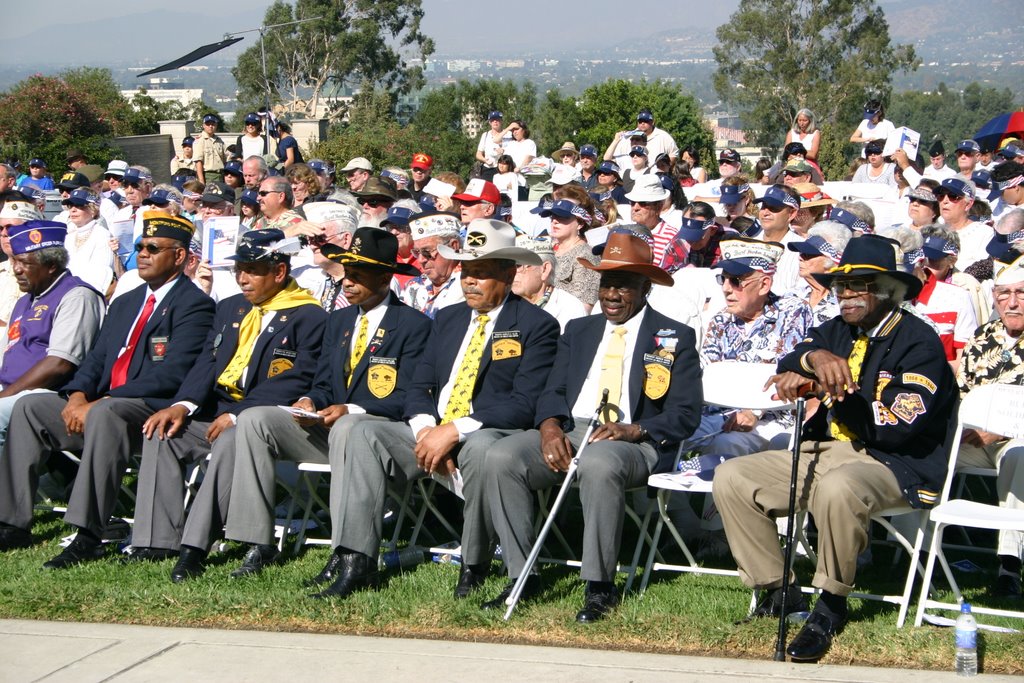
Hollywood Forest Lawn 2006 Veterans Day Program. Seated from left to right are: Trooper Phil Wilkes Fixico, Trooper Lennister Williams, Trooper Charles Allen, Trooper Andrew Aaron and 90 year old, Trooper Robert McDaniel.

Trooper Andrew Aaron (24th Infantry - Korean War vetran) is interviewed by a local news station.

Trooper Lennister Williams with local Los Angeles News Anchor, Stan Chambers, who was this years Master of Ceremony for the Veterans Day program.

Trooper Robert McDaniel (9th Cavalry WWII veteran) with Stan Chambers

Los Angeles Chapter 9th and 10th (Horse) Cavalry Association members with local area scouts and scout leaders

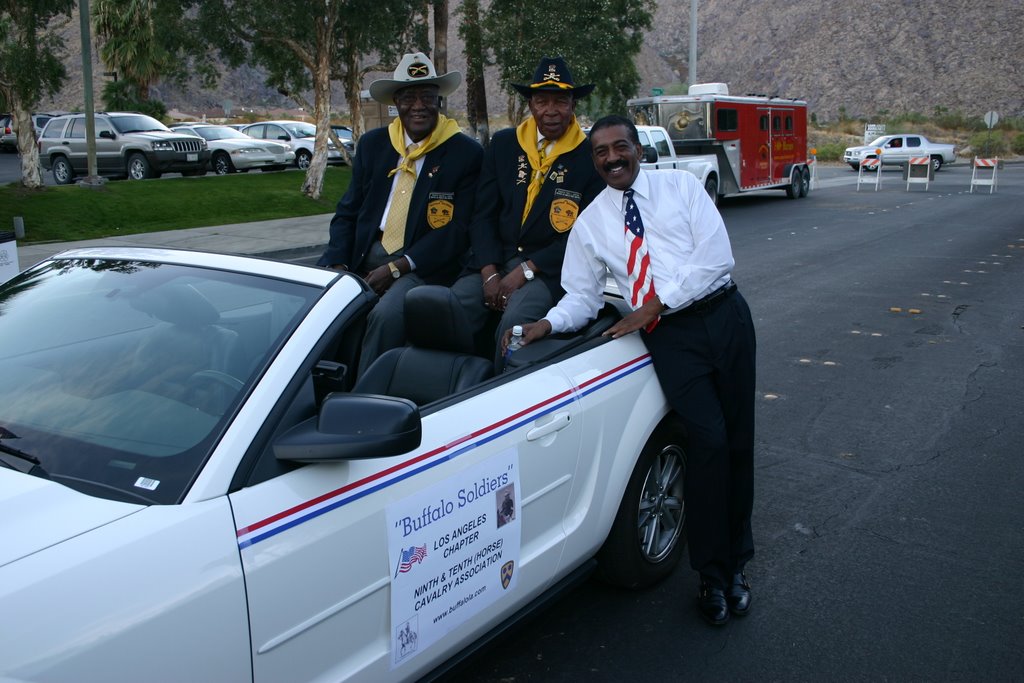
Trooper Andrew Isaacs and Trooper Fred Cartha (both 10th Cavalry - WWII veterans) with the Mayor of Palm Springs, Ron Oden just before the start of the Palm Springs Veterans Day parade.

Trooper Fred Cartha with the mounted unit from Ft Irwin

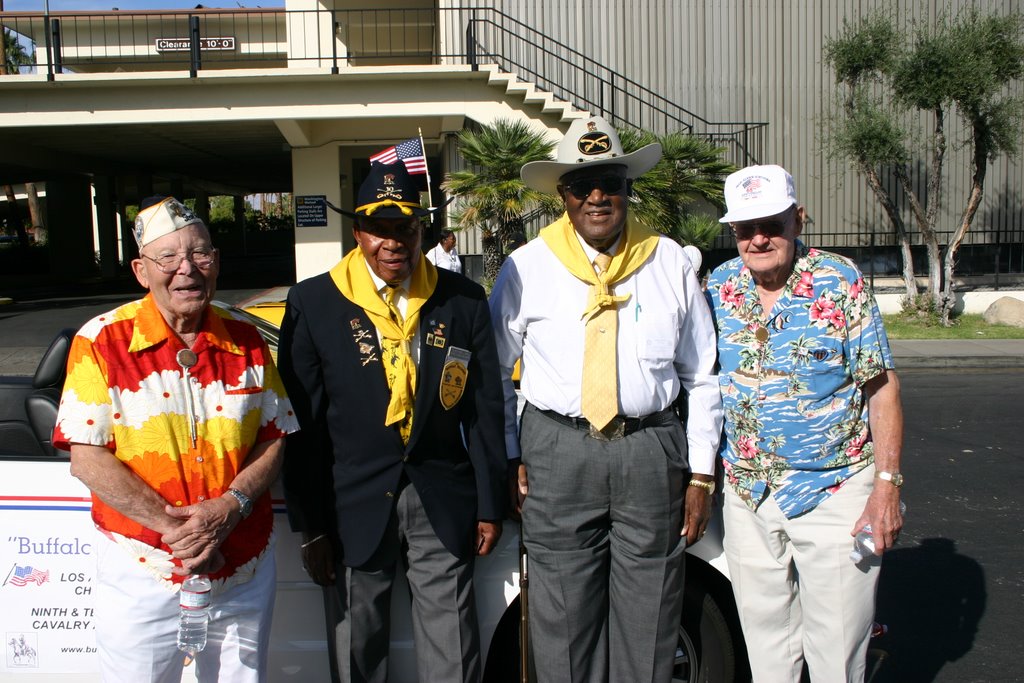
Troopers Carth and Isaacs with Pearl Harbor survivors

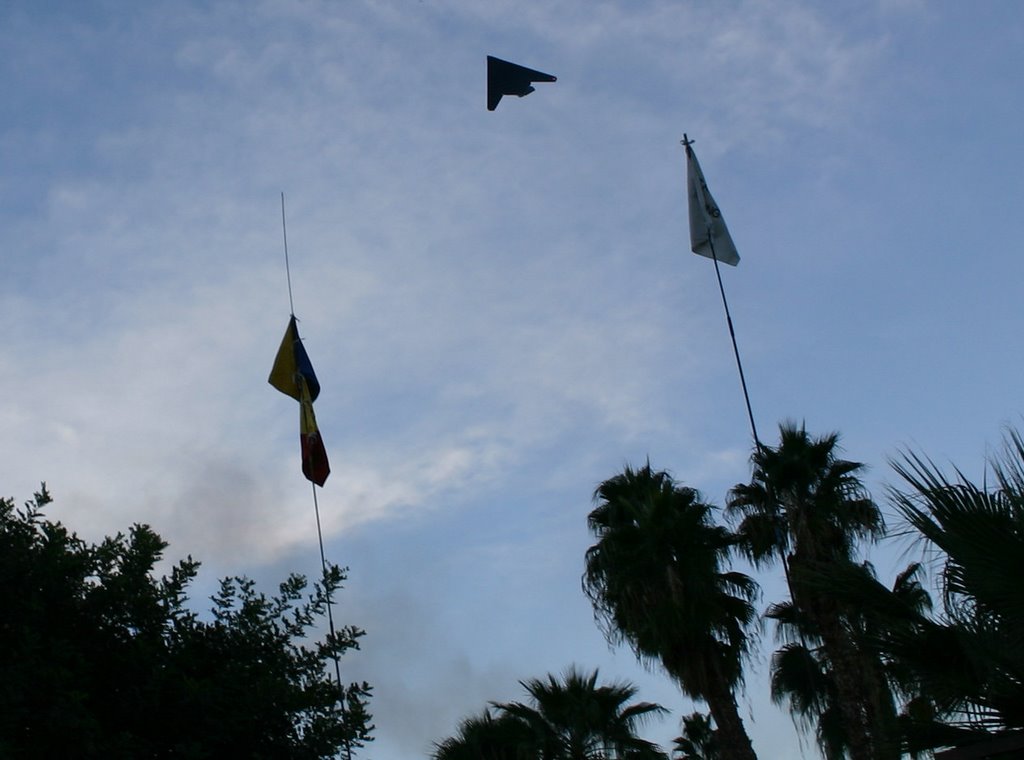
Spectators at the Palm Springs Veterans Day parade were treated by a flyover of a F-17 Night Hawk stealth fighter.

Looking down the parade route in Palm Springs just before the start of the parade.

Monday, November 20, 2006

89 Year Old WWII Buffalo Soldier Willie Jones Prepares to Retire Again

Photo By: Lui Kit Wong/The News Tribune
William Jones, better known as Mr. Jones, spent 22 years in the Army as a Buffalo Soldier before retiring as a master sergeant. After 54 years in Tacoma as the man who has everything, he’s ready to retire again.

I came across an article on Mr. Jones while doing some research on the Buffalo Soldiers. In the article a phone number was listed so I called it. What a pleasant surprise it was when I heard a voice answer, "Mr. Jones!" After I explained that my name was Jones too, and that I am a member of the 9th 10th (Horse) Cavalry Association in Los Angeles, I spent a very pleasant time talking with Mr. Jones and his daughter Lia.

Mr. Jones is looking forward to retiring, but he'll keep busy with his 9th and 10th (Horse) Cavalry Museum. He has one of the country's largest collection of out of print books about the Buffalo Soldiers.

Mr. Jones served in the 10th Cavalry at Camp Lockett and possible knew my father along with Trooper George Poston (deceased) and our current Chapter PresidentTrooper Eugene Lewis.

To find out more about Trooper Willie Jones click on this link:

Buffalo Soldier National Museum Acquires Historic Colletion

The Buffalo Soldier Museum in Houston, Texas recently received a substantial donation of military uniforms, weapons, pictures and diaries that tells the story of black soldiers from the end of the Civil War to World War I. The collection belonged to Anthony Powell, a historian who lives in California's Bay Area. Mr. Powell packed up his collection and drove a Budget rental truck 2,000 miles to deliver 13 crates of military memorabilia to the Buffalo Soldier National Museum.

Pictured here is Trooper PJ Matthews, the museum curator.

For more information about Mr. Powell's donation click on this link: