Showing posts with label history. Show all posts

Tuesday, December 28, 2010

BUGLE CALL - BUFFALO SOLDIER NEWSLETTERS

Over the years I have tried to keep our members informed by periodically publishing a newsletter that I call, "BUGLE CALL." I didn't know what I was doing when I started and I still don't know what I'm doing, but I've always tried to do the best I could. That is all I can ask of myself.

My blog gives me the opportunity to archive these newsletters and make them available to the world. They were produced for members of the Greater Los Angeles Area Chapter of the NINTH & TENTH (HORSE) CAVALRY ASSOCIATION and now we share them with you.

Enjoy.

Newsletter APR 2004


Friday, November 6, 2009

A House is not a Home

I’ve stood at the entrance of St. Patrick’s Cathedral in New York City. It is an architectural wonder with beautiful statuary and priceless works of art. There are many altars within the cathedral adorned in gold and jewels. When I asked, “What is this place?” I was told, this is God’s house! As a child, I’ve camped alongside the King’s River and I’ve slept outdoors at the foot of a Giant Sequoia Redwood in Sequoia National Forest; looked up at the sky at night and saw more stars than I have ever seen in my entire life. When I asked, “What is this place?” I was told, this is God’s home!

In God’s house there is a golden chalice, used for the consecration and distribution of sacramental wine and it is kept on an altar, but in God’s home I’ve stood on the snow-covered-rim of Crater Lake and seen water so blue and so pure that I knew ...this is where God dips his cup.

This month your local PBS stations broadcasted a six part Ken Burns series titled: “The National Parks: America’s Best Idea.” The Buffalo Soldiers’ contributions to our National Parks were highlighted in the series and we are very thankful to Ken Burns for the recognition, but this series goes well beyond the contribution of any individual(s). There is a synergy to the efforts of the men and women highlighted in this series and it is their combined and sustained effort that has made our National Parks and the National Park Service what they are today.

If you haven’t seen this series check with you local PBS station or request it. If you can afford it, buy it. You will be a better person for the experience. This series took me back to my youth, traveling to our National Monuments and camping in our National Parks. FYI, just one percent of the visitors to Yosemite National Park are Black. That’s a Fact!

Sometimes we have to step out of God’s house and into God’s home to realize the awesome responsibility we have, not just to our families, our church families and to each other, but to the land and the water and to this planet as a whole; for this isn’t just God’s home, it’s our home too!

Sunday, September 27, 2009

Fiddler's Green

One of the greatest duties one military person can bestow on another is seeing to it that a fallen soldier is sent off to their final resting place in a very dignified and respectful way. This honor is made even more significant when it is a trooper who has come to the end of his journey.

It said that men of war will never make it through the gates of Heaven. But for those who have performed their duties very well there is a special place that is set aside just for them. For the men who served in the U. S. Calvary that place is Fiddler's Green!

Traditionally the poem, Fiddler's Green, is read by a fellow trooper during the "home going" ceremony of a fallen comrade. So it is very understandable if the words seem to get stuck when it is time to say goodbye.

Trooper Lennister Williams, with the Los Angeles Chapter of the 9th & 10th (Horse) Cavalry Association, reads Fiddler's Green at a recent ceremony for one of our members.


Thursday, August 27, 2009

Col. Charles Young Petition

Did You Know?

There is a grassroots effort in place to have Colonel Young, posthumously promoted to Brigadier General.


I first became aware of this project when Trooper Yolanda Williams (President of the Inland Empire Buffalo Soldier Heritage Association) asked me to participate in a letter writing campaign, to my State and National Congressional and Senatorial Representatives. Since that introduction, from Trooper Williams, there has been a ground swell of interest in this project and the Los Banos Chamber of Commerce and the Los Banos Chapter of the NINTH & TENTH (HORSE) CAVALRY ASSOCIATION, have taken a proactive roll to make sure this effort comes to fruition.

In 2007, when Trooper Bobby McDonald ran for National President of the 9th & 10th (Horse) Cavalry Association, his campaign slogan was; “Preserving, Promoting & Perpetuating the history of the Buffalo Soldiers”. That is our, Millstone! As members of this great organization we have a moral responsibility to the OBS (Original Buffalo Soldiers); those that have gone on to Fiddler’s Green and to those Originals who are still with us. We owe them our dedication and our trust that we will always attempt to do the right thing. If an organization or a group of organizations are trying to both figuratively and literally Promote the accomplishments of Col. Young, then it is our responsibility to get onboard and help guarantee the success of this endeavor.

I wish to salute to efforts of: Trooper David Ofwono, President of the Los Banos Buffalo Soldiers, along with Troopers: Geneva Brett, Kevin Craig, Jeff Periera, Phil Colman and Aimbrell Shanks, all Board members of the Los Banos Buffalo Soldiers - NINTH & TENTH (HORSE) CAVALRY ASSOCIATION; ...I salute them for rolling up their sleeves and getting involved.

How do we get involved?

The Los Banos Buffalo Soldiers Chapter has made it very easy for any of us who want to help and that should be anyone who is reading this article. Just go to their website:

www.losbanosbuffalosoldiers.org

Click on the “Promote Charles Young to General” link, and sign the petition. That’s all there is to it. Signing the petition is a three of four step process. Make sure you go through all the steps in order for your entry to be registered. I’ve already signed, just look for Trooper Ron Jones, California... I’ll be looking for your entry.

Thursday, August 6, 2009

A Brief History of Camp Lockett

A Brief History
by
Trooper Fred D. Jones - 28th Cavalry Troop C
WWII Buffalo Soldier

Camp Lockett's site was chosen for a cavalry camp as far back as 1878 when sixteen troopers wearing the blue uniform of The US Cavalry bivouacked for several months in this small Mexican border valley. At that time it took a week to get to San Diego, the choicest acres of bottom land sold for $5 an acre, smugglers and belligerent, "Indians" were problems.

"E" Troop of the 11th Cavalry Regiment was stationed here in 1918 and since then therehave been a succession of home soldiers stationed at this strategic junction where road and rail road return to the United States after dipping into Baja California en route from San Diego to Yuma.

Ground was broken for the present camp on June 23rd 1941. The 11th Cavalry Regiment came there two days after the bombing of Pearl Harbor. Camp Lockett is a horse cavalry camp. The surrounding terrain offers unparalleled opportunities to test man, beast and mechanized carriers over a wide variety of terrain that includes heavily wooded underbrush, desert sand, miles of barren, rocky wastelands, Streams to be forded, and other geographic hazards identical to those which confront cavalry troopers in battle conditions.

Climatically this is a region of extremes. There is summer heat of 115 degrees; freezing temperature in winter. Long dry spells alternate with cloudbursts.
2d Cavalry Division Shoulder Sleeve Insignia

Some of the buildings were built as permanent cantonments while others were semi-permanent. The semi-permanent buildings no longer exist. There was a well equipped hospital which is now used as a youth facility. There are still standing many of the permanent barracks and some stables.

In 1942, the 10th Cavalry Regiment (the famed Buffalo Soldiers) moved into Camp Lockett to replace the11th Cavalry Regiment which had been converted into an armored unit. In 1943 The 28th Cavalry Regiment made up of inductees joined the 10th to form the 4th Cavalry Brigade of the 2nd Cavalry Division (Horse)

At the same time The 27th Cavalry Regiment, also made up of inductees, joined the 9th Cavalry Regiment to form the 5th Cavalry Brigade. This brigade was stationed in Fort Clark, Texas. Their duty was to guard the Texas-Mexican Border. While the 10th and 28th guarded the California-Mexican Border. These troopers also guarded the many installations along the border such as, trestles, bridges, dams, railroad tunnels and would be the first line of defense in case Germany or Japan attempted an invasion of the United States through Mexico.

In 1944 The 9th, 10th, 27th and 28th were dismounted and sent to North Africa. Soon after their arrival there all four regiments were inactivated and converted into service troops. This marked the end of the horse cavalry in the United States Army. The 28th, through an error was not officially inactivated until 1951.This makes Camp Lockett the last home of the last horse cavalry in the US Army.

Note: Information obtained from The California State Military Museum

A Moment in History

A Moment in History

By Adrian O' Connor & Trooper Houston Wedlock

In 1913, the Buffalo Soldiers Came to Winchester

Their band played “Dixie.”

Ninety-six years ago this summer, on the morning of July 19, 1913, troopers of the 10th U.S. Cavalry, more than 700 strong and led by their regimental band, rode into Winchester.

As the horsemen displayed their prowess in the saddle, the unit’s 28 musicians warmed the hearts of the local residents who lined Main (now Loudoun) Street by playing the tune most associated with the cause of Southern independence.

That this scene was touched by a certain undeniable irony is evident in the identity of the troopers. Though commanded by white officers, the 10th Cavalry was, in its rank and file, an all-black regiment.

Many were the sons of freed slaves. Others were descendants of black Civil War veterans. All were known by the name given in honor by the Cheyenne during the Indian Wars — “Buffalo Soldiers.”

That unusual demonstration in the streets of Winchester — black musicians playing the popular Confederate anthem in a Southern town — was but a foreshadowing of a unique, albeit largely unknown, episode in the history of the northern Shenandoah Valley.

For two months that summer, a sprawling “camp of cavalry instruction” occupied 1,200 acres along the Front Royal Road.

For the Buffalo Soldiers of the 10th Cavalry, the road to “Dixie” — and the streets of Winchester — began more than a month and 706 miles earlier, at Fort Ethan Allen, Vt.

Hard as it may be to imagine now, the U.S. War Department would often hold peacetime maneuvers in locales far removed from its forts, or bases of operations.

Such was the case in 1913 when the 10th Cavalry left Fort Ethan Allen for a handpicked site in Frederick County.

To move the largest cavalry command the Valley would see since Union Gen. Philip Sheridan put the Shenandoah to the torch in 1864 was a considerable undertaking.

More than 700 men — 680 troopers and 30 officers — left Vermont on June 16 with 800 horses and mules and 36 wagons stocked with provisions.

The line of march led the 10th through such cities and towns as Burlington and Hubbardton in Vermont and Saratoga Springs, Schenectady, Cobleskill, Oneonta, and Sidney in New York.

In Winchester, the regiment would be joined by the 11th Cavalry, based in Fort Oglethorpe, Ga., and selected troops from the 15th Cavalry, stationed at Fort Sheridan, Ill. — all-white regiments both.

The 10th’s journey south was largely uneventful, save for an incident in Carlisle, Pa., in which a young woman said a black trooper had assaulted her and knocked her escort unconscious. However, after two examinations of the entire command did not yield a positive identification of the assailant, it was concluded that a cavalryman was not to blame for the crime.

By July 17, the Buffalo Soldiers, averaging a crisp 23 miles a day, had reached Williamsport, Md., where they camped for the night. The next day found them at Darkesville, W.Va., south of Martinsburg, their last stop before establishing their bivouac outside Winchester.

When the Buffalo Soldiers stepped proudly on parade through the city on July 19, the lion’s share of the 15th Cavalry was already in camp, having arrived the day before.

By nightfall of July 20, other detachments from the 15th made it to the camp on the high, rolling terrain blessed with a perfect view of the distant Blue Ridge. (The site is roughly five miles down U.S. 522 from the Interstate 81/U.S. 50 interchange, across from the aptly named Fort View Motel).

Troops B, C, and D had spent two days at the Antietam battlefield in Maryland; another group, accompanied by a battery of field artillery, would come rolling into town on Baltimore & Ohio railroad cars from Fort Sheridan.

This swelled the ranks to roughly 2,100 men.

Two more troops, one each from the 11th and 15th regiments, would come late the following week, pushing the total to nearly 2,500.

In charge of the camp was Col. Cunliffe H. Murray of the 12th Cavalry. Leading the Buffalo Soldiers was a relatively new commander, Col. John C. Gresham, who had replaced Col. Thaddeus W. Jones, a veteran of 40 years in the saddle, the previous October.

As expected, a “state of chaos and confusion” reigned in those early hours of camp, as The Star noted in its columns of July 21. But order eventually prevailed.

A field hospital quickly took shape, as did a post exchange and a post office.

However, the Army could do little to prevent the hurlyburly on the Front Royal Road outside the camp.

A swarm of vendors had set up shanties selling candy, fruit, cakes, and soft drinks to the throngs of visitors who flocked to the site to observe what the Army had in store for the next two months.

Over that period, the assembled cavalrymen would engage in tactical maneuvers, simulated war games, field exercises, and horsemanship and saber competitions.

As Col. Murray told The Star, the real instruction would begin at 7 a.m. on Wednesday, July 23.

Houston Wedlock is not a man given to craziness.

Such a state of mind hardly becomes a person of his stature. A Green Beret, Wedlock retired from the Army in 1974 after 20 years of service — with 498 airplane jumps and two tours of Vietnam under his belt.

And yet, upon discovering that the Buffalo Soldiers had actually bivouacked near Winchester, he said, “I went crazy.”

But for good reason.

Now a resident of Columbia, Md., Wedlock, 66 (at the time of this original article), was born and raised in the Clarke County community of White Post, just a short gallop from the site of that “camp of cavalry instruction” on the Front Royal Road.

“I never knew they were here,” he said. “This was home, and this is a nice piece of history for the town.”

And “a nice piece of history” for a re-enactor and member of the 9th and 10th Horse Cavalry Association to pursue.

Together with Air Force veteran Stanley Lawson, another native of White Post, and Isaac Prentice of Fort Washington, Md., Wedlock formed the “Research Re-enactors” back in the ’90s.

The group is dedicated to all things Buffalo Soldier as well as to the history of the four historically all-black regiments — the 9th and 10th Cavalry and the 24th and 25th U.S. Infantry — known collectively by that name.

The three men — all retired or, in Wedlock’s case, semi-retired — couple their interest in history with a devotion to community outreach.

Donning distinctive period dress, they’ve brought the story of the Buffalo Soldiers to schools, churches, and federal agencies. They’ve done television shows and participated in parades and marches all over the Washington, D.C., area and beyond — particularly during February, Black History Month.

But, as Prentice points out, what they strive to teach is “not black history, but American history.”

“These men,” he said, “were Americans. Their stories are American stories.”

Prentice, through his uniform, has a particular story to tell — that of Capt. Henry Vinton Plummer, the first black chaplain in the U.S. Army after Reconstruction.

Born a slave in Prince George’s County, Md., in 1844, Plummer received an appointment to the 9th Cavalry in 1884 and served as chaplain to that unit for the ensuing 10 years.

Wedlock and Lawson, meanwhile, appear in generic cavalry uniforms, circa 1885. Wedlock wears the mounted uniform of a first sergeant; Lawson sports a sergeant’s field uniform, complete with the distinctive yellow trooper’s gloves.

“It’s an interesting hobby,” Wedlock said. “We’ve been to so many schools in [the Winchester] area, but we couldnever tell the kids the Buffalo Soldiers were here. Now we can.”

Toward that informational end, Wedlock has immersed himself in the lore of that 1913 venture.

Using the records on file at Carlisle Barracks (the U.S. Army War College in Carlisle, Pa.), he has meticulously tracked the route of the 10th Cavalry from Fort Ethan Allen to Winchester.

Through his research, Wedlock has a theory as to why Winchester was chosen as the site for this camp.

The northern Valley, he says, was centrally located for the three regiments that would participate in the camp of instruction. What’s more, it was close enough for officials of the War Department (Secretary Lindley M. Garrison, for example) and the central command (Army Chief of Staff Gen. Leonard Wood) to come from Washington to review the troops.

From a historical perspective, Wedlock notices too a certain symmetry in the selection of Winchester. A goodly number of Buffalo Soldiers, he says, hailed from this general area.

Lawson, for instance, likes to point out that Trooper (Pvt.) Charles Davis was reared in White Post, where the house in which he grew up still stands. Davis, however, did not take part in the 1913 camp, as he was a member of the 9th Cavalry.

That Davis’ memory lives on can be attributed not merely to Wedlock and Lawson. His kinfolk — in particular, three generations of Ford men, all named Edwin James — still reside in the Valley.

In fact, Edwin James Ford Jr. of Winchester happily provided the photos of his great uncle that appear with this article.

The memories of other Buffalo Soldiers remain fresh, largely due to the re-enactors’ joyful efforts to keep the legacy before the public.

Wedlock, for example, clearly relishes his role as historian and story-teller. One of his more interesting tales is that of Cathay Williams, who, as William Cathey, disguised herself as a man and joined the BuffaloSoldiers shortly after the Civil War.

Tall and slender at 5 foot 9, she managed to remain a trooper for two years (18661868) without being discovered.

Even Cathay, said Wedlock, has a northern Valley connection, having served as cook and washerwoman to the staff of Gen. Phil Sheridan when it was based in Winchester during the climactic Valley Campaign of 1864.

The 10th U.S. Cavalry was commissioned and activated at Fort Leavenworth, Kan., on July 28, 1866.

It did not take long for the black troopers — freed slaves and Civil War veterans — to make a name for themselves.

While patrolling the Kansas Pacific Railroad in the summer of 1867, the 10th, commanded by Col. Benjamin H. Grierson, twice engaged larger bands of Cheyenne in sharp combat.

It was after these clashes that the Cheyenne dubbedtheir blue-clad foe “Buffalo Soldiers” — for their skin color, for their short, wooly hair, and, most of all, for their fierceness in battle.

The appellation soon became a badge of honor. The10th, in time, included a buffalo figure as part of its insignia.

Later that year, riding with Sheridan, the 10th vigorously pursued — and eventually captured — the famous Cheyenne leader Black Kettle and his warrior band through a blinding snowstorm. This episode added to the regiment’s growing legend.

Though the 10th would be involved in 177 separate engagements over the course of the protracted Indian Wars, much of their duty was considerably more prosaic.

In addition to fighting Indians, the Buffalo Soldiersscouted and patrolled a 34,420-mile area of the Western plains, laid hundreds of miles of new railroad track, put up new telegraph lines, protected mail coaches, arrested cattle rustlers and bandits, and escorted settlers, railroad crews, and even herds of cattle to their respective destinations in the West.

Together with the other allblack horse regiment, the 9th,the Buffalo Soldiers of the 10th comprised 20 percent of the cavalry stationed in the West.

During the Indian Wars, no less than 18 BuffaloSoldiers received the Medal of Honor, with Sgt. Emanuel Stance being the first such honoree.

What’s more, the black regiments boasted the lowest rate of desertion — 4 percent — in the Army. Overall, this rate ran as high as 25 percent.

Nonetheless, certain officers — Gen. George Armstrong Custer being the most noteworthy — were either reluctant or outright refused to place the black troopers under their command.

A notable exception was future General of the Armies John J. “Black Jack” Pershing, who, early in his career, was a junior officer in the 10th. In fact, his nickname can be traced to those days in the 1890s when he led black troops.

Late in the Indian Wars, the 10th was instrumental in chasing down the two renegade Apache chieftains, Victorio and Geronimo. Then, roughly a decade later, they fought heroically alongside Teddy Roosevelt and the Rough Riders in their fabled charge up San Juan Hill during the Spanish-American War.

In 1909, in response to allegations of discrimination — it was said the black regiments were given the worst billets even when they requested better — the Army decided to move the 10th east to the relative comfort of Fort Ethan Allen with its indoor riding hall and superbly equipped gymnasium.

And it was from there, of course, that the 10th left on its 706-mile trek to Winchester and the “camp of cavalry instruction” on the Front Royal Road.

That the troopers of the 10th, 11th, and 15th Cavalry quickly became a part of the Winchester community during their two-month stay can be evidenced on the pages of The Star.

For example, the cavalry officers sponsored a dance (Aug. 4); the precision-riding troopers were the hit of a talent show to benefit the Winchester hospital (Aug. 20); and the camp opened its tent flaps to the public for a “moving pictures” program (Aug. 30) and then for a minstrel show (Sept. 6).

The highlight of their immersion in local affairs came during the second week of September when, as part of the Winchester Fair, the Army horse soldiers displayed their talents in cavalry drills and races to crowds numbering — in The Star’s estimate — as high as 12,000 people.

To be sure, the camp did experience its share of untoward bumps during those two months in the Valley.

The local constabulary seized a stash of illegal liquor on Aug. 11; “sundry offenses” by troopers necessitated a series of courts-martial on Aug. 19; and, on Sept. 5, a lovesick trooper from the 11th Cavalry — Ernest Baker — committed suicide when his fianceé “threw him over.”

However, the incident that caused the most stir among the local populace came early in the Army’s prolonged visit.

On July 25, Frederick County Sheriff Luther Pannett, with the cooperation of Lt. Arthur Conrad of the 10th Cavalry, arrested two white women in a tent at the edge of camp.

The women, said to be French-Canadian, were caught in the company of six black troopers, all of whom escaped in the chaotic raid. One, however, cut himself severely on a wire fence, necessitating a trip to the Army’s field hospital.

It was not until four days later that police in Harrisburg, Pa., nabbed the raid’s foremost target — a mulatto named Samuel Franklin allegedly engaged in the white slave trade.

For the most part, the Army earned praise for its exemplary conduct. In fact, Winchester Police Chief M.A. Doran saw fit to respond to a Baltimore Sun article of July 27 that stated black troopers were misbehaving on the streets of Winchester, to the point of pushing residents off the sidewalks.

Quickly dismissing the allegations, Doran informed Col. Gresham, commander of the 10th, that “there has not been a single complaint regarding the conduct of either the white or colored troopers, but on the other hand they have conducted themselves at all times in a quiet and orderly fashion.”

In late September, the big brass — Secretary of War Garrison and Army Chief of Staff Gen. Wood — visited Winchester to survey the camp and review the troops.

Then, beginning on the evening of Sept. 29, the three regiments commenced breaking camp.

By 8 a.m. on Sept. 30, they were gone.

The 10th Cavalry made its way to Roslyn, across the Potomac River from Washington, where, in the second week of October, it conducted exercises and passed in review before President Woodrow Wilson.

On Oct. 11, the regiment left by train for Fort Ethan Allen.

The 10th’s days in Vermont, however, were shortlived. In November and December of 1913, the BuffaloSoldiers left the comfort of the fort and returned to the Southwest.

Stationed at Fort Huachuca in Arizona, they patrolled the volatile Mexican border, often crossing into Mexico to pursue bandits and gun-runners from that politically unstable nation.

Later, the Buffalo Soldiers would fight together in both world wars and in Korea.

After the armed forces were desegregated in 1952, soldiers from these previously all-black regiments were absorbed into other units.

Though the Buffalo Soldiers are now consigned to history, the 9th and 10th Cavalry live on, reincarnated as regiments of armor. The 24th Infantry, the last all-black regiment to see action (in Korea), remains on the Army’s rolls; the 25th Infantry, however, was disbanded.

While it’s safe to assume that those rolling hills of southeastern Frederick County will never again feel the synchronized tumult of pounding hooves or hear the lonesome sounds of morning reveille or nightly “Taps,” that very ground may one day witness the return of horses, mules, and excited riders.

That is, if Houston Wedlock can somehow turn a dream into reality.

Only this time, the horsemen, as it were, will not be the seasoned troopers of old, but children, youths whose lives have been fractured by neglect and abuse.

Shortly after retiring from his second career, as a regional administrator for Preston Trucking Co., Wedlock became involved with Vision Quest, a nationwide program for at-risk youth based in Tucson, Ariz.

These children are adjudicated to Vision Quest’s care from juvenile courts. For the past 29 years, the organization, which receives funding from individual states, has employed a rigorous program grounded in military discipline to help these youngsters attain a proper path in life.

An unusual feature of the program — and one near and dear to Wedlock’s heart — gives each child the responsibility of caring for an animal, usually a horse. Regionally, Vision Quest has a camp in Pennsylvania, near South Mountain, where these animals are quartered.

“We try to keep the kids busy,” Wedlock said. “We show them that they should give something back [to the community].”

Wedlock’s dream, therefore, is to bring his Vision Quest youth to Frederick County and re-create the encampment of 1913 on the very property where theBuffalo Soldiers once rode.

This is hardly an idle “vision” — or “quest,” for that matter. He has already done a similar re-enactment, based on the history of Custer’s 7th Cavalry, in Montana.

Wedlock originally hoped to put such an event together in years past, but work with Vision Quest kept him on the road virtually the entire summer.

But, guided by the spirit of the Buffalo Soldiers of yore, he has set his sights to the future, when on the anniversary of their arrival, he will celebrate, with the young troopers, when the rolling thunder of galloping steeds could be heard up and down the Front Royal Road.

Note: Slight edits were made to the article to update certain time lines. The photo of Trooper Wedlock was made available by the Vermont Area 9th & 10th (Horse) Cavalry Association. Vermont-Buffalo-Soldiers - Fort Ethan Allen


Thursday, February 22, 2007

NAACP CELEBRATES THE LIFE OF DR. WILLIAM HENRY WADDELL IV

Source: HTTP://WWW.NAACP.ORG/NEWS/PRESS/2007-02-09/INDEX.HTML

Feb. 9, 2007

Dr. William Henry Waddell IV

The NAACP celebrates the life of Dr. William Henry Waddell IV, the nation’s second-oldest known Buffalo Soldier, a pioneer in the field of veterinary medicine and a lifetime NAACP member. He died January 30 in Hawaii at the age of 98.

A man of many “firsts,” Waddell was born in South Richmond, Va. in 1908. He studied veterinary medicine at Lincoln University and passed the Pennsylvania State Board of Veterinary Medicine in 1935, becoming the first licensed black veterinarian in the state. Waddell later co-founded the Tuskegee Institute School of Veterinary Medicine, where he served as the school’s first faculty member and worked with George Washington Carver on peanut oil therapy. Waddell was also the first black member of the American Veterinary Medicine Association and the first black veterinarian to practice in West Virginia.

From 1941 to 1946 Waddell served the U.S. 9th and 10th Cavalry Regiments of the United States Army as a Buffalo Soldier. The Buffalo Soldiers were originally established by Congress as the first peacetime all-black regiments in the United States Army, but later operated during wartime. Waddell served abroad during the Italian campaign of World War II and was later wounded in action in North Africa.
Waddell was the second oldest of two surviving Buffalo Soldiers, and the last member of the 9th and 10th Calvary Regiments. He continued to attend Buffalo Soldier reunions each year up until his death. Joe Barnes of San Francisco is said to be the oldest known and sole remaining Buffalo Soldier.

After the war, Waddell opened a veterinary clinic in Tuskegee, Ala. and continued his affiliation with Tuskegee University. He was honored for his contributions to the veterinary school in 2004.

Among his many honors, Waddell received an honorary Doctor of Science degree from Lincoln University and a lifetime achievement award at the National Veterinary Association meeting in Honolulu last year. An annual scholarship named in his honor was recently instituted by the NAACP Honolulu Branch.
Waddell is remembered as a wise and exceptionally kind man who encouraged youth to seek knowledge and education. He is survived by a host of loving relatives and family friends and will be sorely missed.

Founded in 1909, the NAACP is the nation's oldest and largest civil rights organization. Its members throughout the United States and the world are the premier advocates for civil rights in their communities, conducting voter mobilization and monitoring equal opportunity in the public and private sectors.

Wednesday, February 21, 2007

1908-2007 William Waddell, Buffalo Soldier

By Will Hoover, Advertiser Staff Writer

William Henry Waddell — one of only two surviving Buffalo Soldiers — died at age 98 Tuesday evening at his home in Ka'a'awa.

Waddell, who retired in Hawai'i in 1972 with his wife Lottie, served from 1941 through 1946 with the 9th and 10th Cavalry during the Italian campaign of World War II.

The term "Buffalo Soldier" is one of pride that harks back to the period immediately following the Civil War when depleted Union troops were, by act of Congress, strengthened for the first time to include six regiments of black soldiers.

The term became synonymous with all black regiments that served during subsequent conflicts including the Spanish American War, World War I, World War II and the Korean War, after which the unit was discontinued.

But Waddell had been a trailblazer before entering the war. In 1935, he made history by becoming the first black to be granted a license to practice veterinary medicine in Pennsylvania after he passed the State Board of Veterinary Medicine.

Waddell, who was born in South Richmond, Va., in 1908, also was the first black to practice veterinary medicine in West Virginia and the first black member of the American Veterinary Medicine Association. He was further honored in 2003 as a co-founder of the historic Tuskegee Institute School of Veterinary Medicine.

"I think he was a great humanitarian," said his daughter Kathryn Waddell Takara, a professor at the University of Hawai'i at Manoa. "He had a kind heart.

"He was a terribly hard worker who came up from nothing. He's my hero."

In 2004 ,Waddell was awarded a doctor of science honorary degree from the Lincoln University in Pennsylvania.

Through it all, Waddell remained a man of warmth and humor. His autobiography, "People are the Funniest Animals," was published in 1978. He also authored several other books.

"He was a grand, grand man," said retired UH professor Miles Jackson, a neighbor of Waddell's. "We all looked upon him as a sage. He had always had positive words of wisdom to share with people.

"He had a fantastic memory. We really enjoyed his company."

To those who knew him, he was an inspiration who will be greatly missed.

"The sad state of affairs is that we began February, Black History Month, with the loss of a national treasure," said Alphonso Braggs, president of Hawai'i NAACP.

"He's the reason that many of us are able to pursue our goals, our dreams and our aspirations. And right up to the end, he was still being that inspirational leader and mentor that he is very well known for.

"The irony is that at this time last year, Dr. Waddell was going around the Island bases with us celebrating Black History Month. So there's going to be that absence this year."

Yet, Braggs and Jackson both praised Waddell for giving those who follow in his footsteps the courage and motivation to continue to carry the message of inspiration and hope forward.
"We can only hope that we are able to live long enough to leave a legacy as great as what he's left us," Braggs said.

At a time when many young people are having trouble understanding the civil rights struggles of the '50s and '60s, he said Waddell's legacy stands as a beacon of light.

Already that legacy has grown. On Jan. 13 — less than a month before his death — the Honolulu Hawai'i branch of the NAACP awarded its first scholarship in Waddell's name, Braggs said.

"We really want to perpetuate what he has done. And that's one way to remind folks," Braggs said.

His wife preceded him in death. Aside from his daughter, survivors include two grandchildren and two great-grandchildren.

Photo from the Buffalo Soldier Research Museum
http://buffalosoldiersresearchmuseum.org/research/books/waddell.htm

This article was published on February 4, 2007

Sunday, December 17, 2006

Breaking bread together for the Holidays

Members of the Los Angeles Chapter of the 9th & 10th (Horse) Cavalry Association, gather for their annual Buffalo Soldier informal luncheon and family get-to-gather.


Pictured above, from left to right seated, are: Trooper Robert McDaniel, World War II veteran who served with the 9th Cavalry regiment stationed at Fort Riley and for a time was a member of headquarter staff and worked for Gen. Benjamin O. Davis Sr., Trooper Alfred Evans, WWII veteran who served with the 10th Cavalry regiment, Trooper John Tull, WWII veteran who served with the 10th Cavalry regiment, Trooper Andrew Isaacs, WWII veteran with the 10th Cavalry regiment and is the newly elected President of the L.A. Chapter, Trooper Eugene Lewis, WWII veteran, 28th Cavalry regiment 'C' Troop, stationed at Camp Lockett in California and outgoing L.A. Chapter President, Trooper Andrew Aaron, Korean War veteran and a member of the 24th Infantry regiment.

Second row: Nathaniel Hosea, WWII veteran and a member of the Mondfort Point Marines, Retired U.S. Army Colonel Franklin Henderson, past National President of the 9th & 10th (Horse) Cavalry Association, Trooper Fred Cartha, WWII veteran, served with the 10th Cavalry regiment and is this year's recipient of the Los Angeles Chapter Buffalo Soldier "Trooper of the Year" award, Trooper Phillip Wilkes Fixico, descendant of the Seminole Negro Indian Scouts, Trooper Jean Lewis, US Army veteran of the Cold War era, Trooper Gwen Jones.

The back five: Trooper Charles Allen, Korean War veteran and a member of the 24th Infantry regiment, Trooper Erich Hicks, Vietnam War veteran, Trooper James Cooper, WWII veteran, served in the 24th Infantry regiment and was a driver in Patton's Red Ball Express, Trooper Walter Brady, Iraqi War veteran, Trooper Lennister Williams, Vietnam War veteran and retired Sgt. Maj U.S. Army.

During WWII and the Korean War, the Buffalo Soldier regiments consisted of the 24th and 25th Infantries and the 9th, 10th, 27th and 28th Cavalries. The cavalry regiments made up the 2nd Cavalry Division which was deactivated in 1944. When President Truman's Executive Order 9981 was fully implemented in 1951, bringing an end to segregation in the arm forces, it closed the door on the history that was the Buffalo Soldiers of the segregated U.S. Army. These men represent the last of the original Buffalo Soldiers who served in those segregated regiments.


Tuesday, November 21, 2006

Recent 2006 Veterans Day Buffalo Soldier Public Appearances

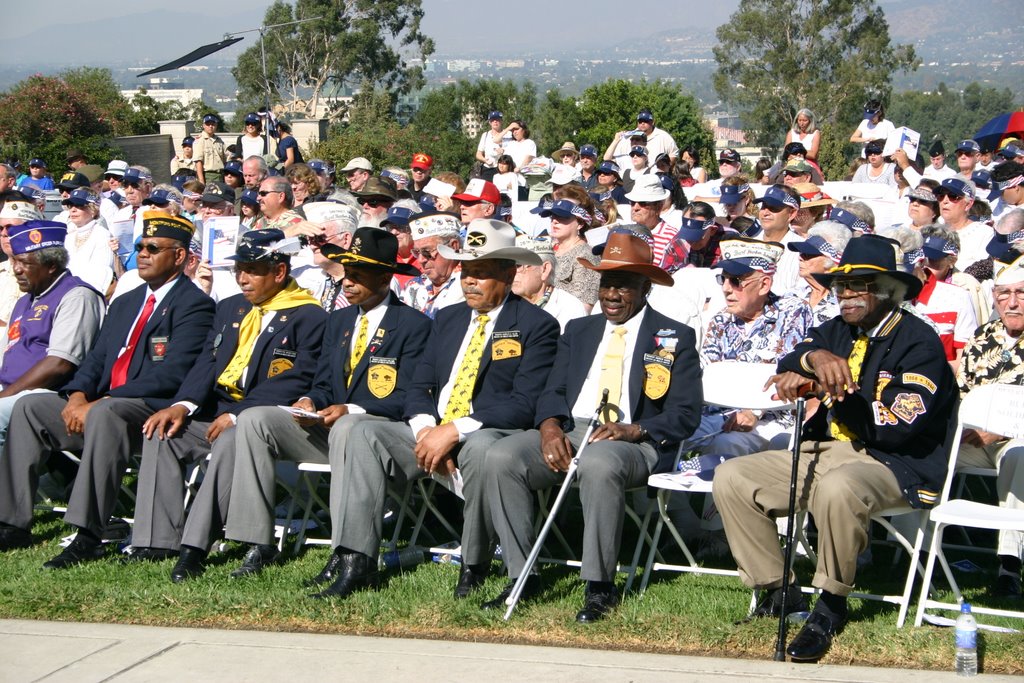
Hollywood Forest Lawn 2006 Veterans Day Program. Seated from left to right are: Trooper Phil Wilkes Fixico, Trooper Lennister Williams, Trooper Charles Allen, Trooper Andrew Aaron and 90 year old, Trooper Robert McDaniel.

Trooper Andrew Aaron (24th Infantry - Korean War vetran) is interviewed by a local news station.

Trooper Lennister Williams with local Los Angeles News Anchor, Stan Chambers, who was this years Master of Ceremony for the Veterans Day program.

Trooper Robert McDaniel (9th Cavalry WWII veteran) with Stan Chambers

Los Angeles Chapter 9th and 10th (Horse) Cavalry Association members with local area scouts and scout leaders

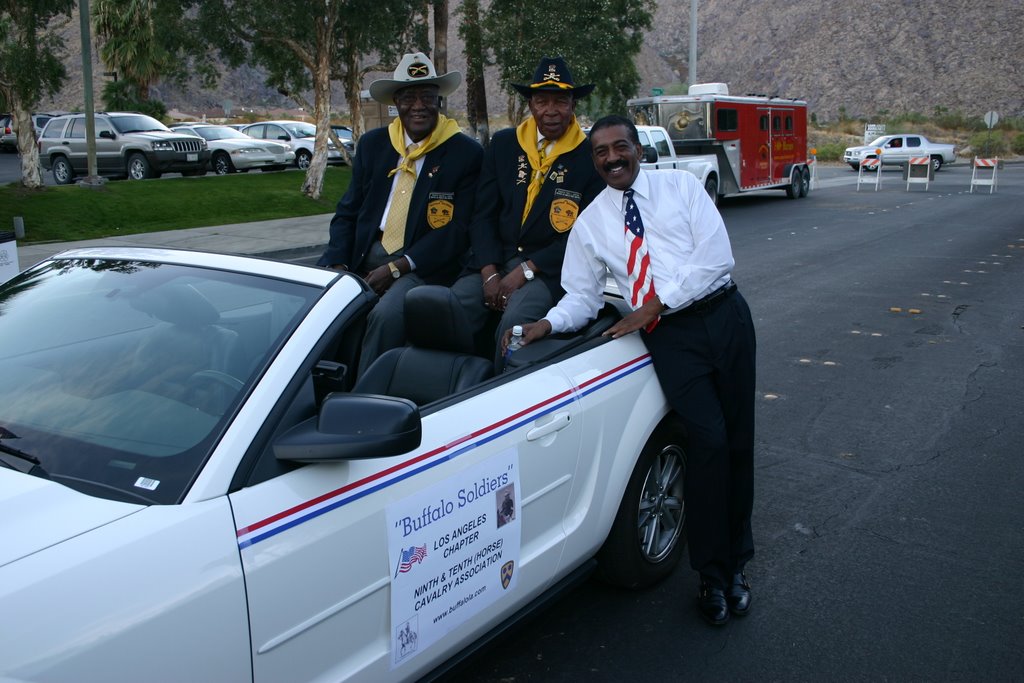
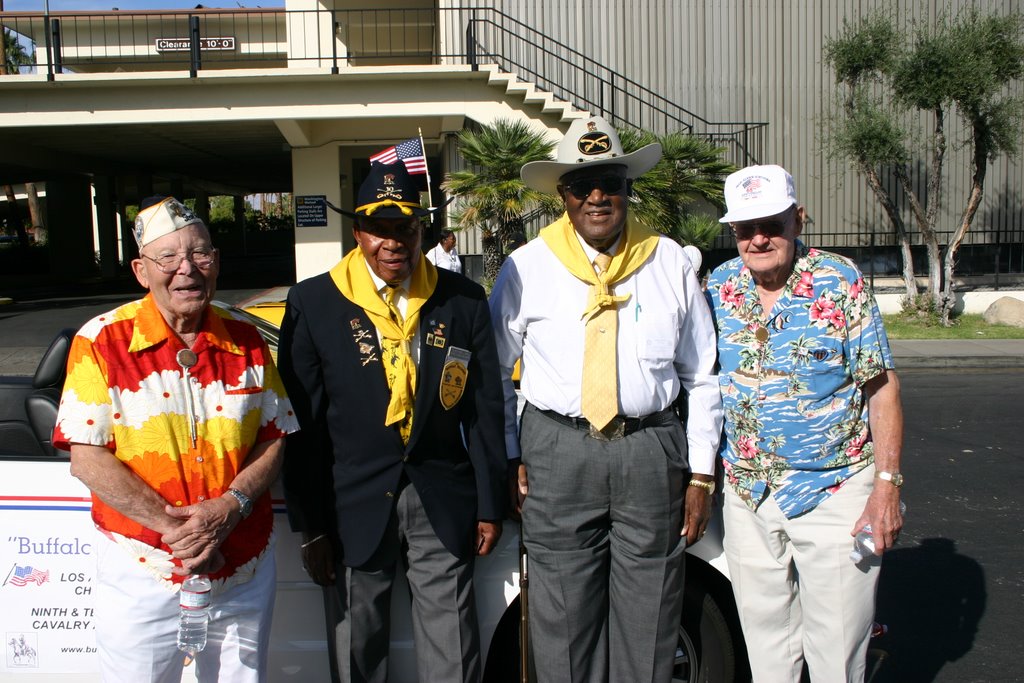
Trooper Andrew Isaacs and Trooper Fred Cartha (both 10th Cavalry - WWII veterans) with the Mayor of Palm Springs, Ron Oden just before the start of the Palm Springs Veterans Day parade.

Trooper Fred Cartha with the mounted unit from Ft Irwin

Troopers Carth and Isaacs with Pearl Harbor survivors

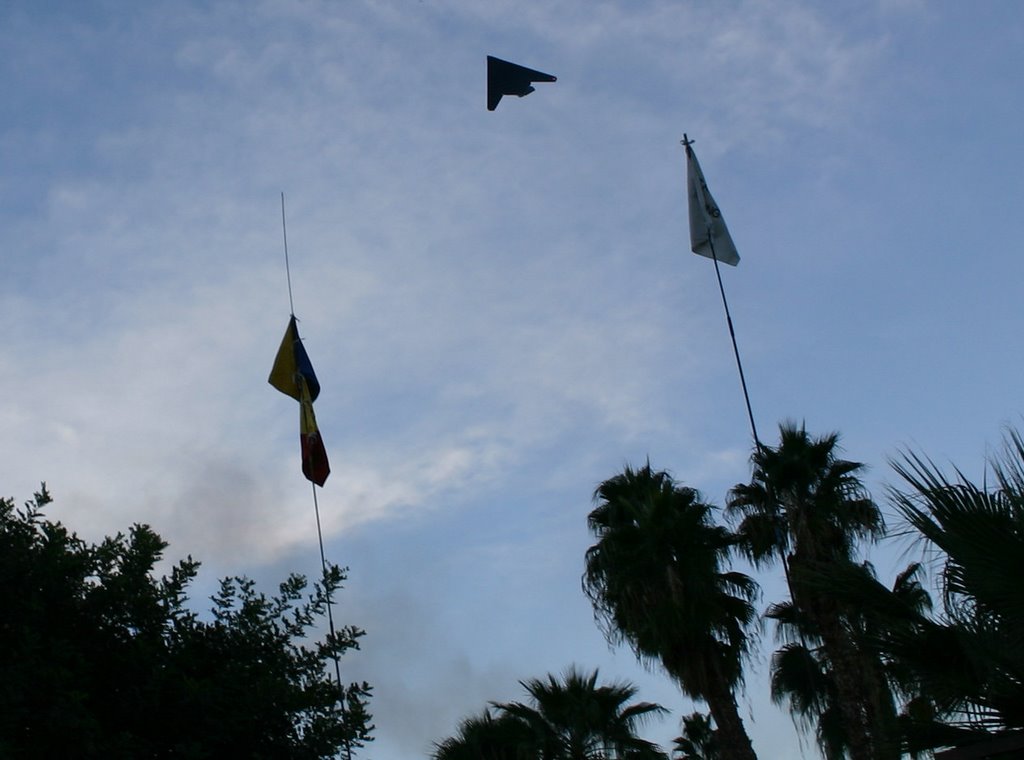
Spectators at the Palm Springs Veterans Day parade were treated by a flyover of a F-17 Night Hawk stealth fighter.

Looking down the parade route in Palm Springs just before the start of the parade.

Monday, November 20, 2006

89 Year Old WWII Buffalo Soldier Willie Jones Prepares to Retire Again

Photo By: Lui Kit Wong/The News Tribune
William Jones, better known as Mr. Jones, spent 22 years in the Army as a Buffalo Soldier before retiring as a master sergeant. After 54 years in Tacoma as the man who has everything, he’s ready to retire again.

I came across an article on Mr. Jones while doing some research on the Buffalo Soldiers. In the article a phone number was listed so I called it. What a pleasant surprise it was when I heard a voice answer, "Mr. Jones!" After I explained that my name was Jones too, and that I am a member of the 9th 10th (Horse) Cavalry Association in Los Angeles, I spent a very pleasant time talking with Mr. Jones and his daughter Lia.

Mr. Jones is looking forward to retiring, but he'll keep busy with his 9th and 10th (Horse) Cavalry Museum. He has one of the country's largest collection of out of print books about the Buffalo Soldiers.

Mr. Jones served in the 10th Cavalry at Camp Lockett and possible knew my father along with Trooper George Poston (deceased) and our current Chapter PresidentTrooper Eugene Lewis.

To find out more about Trooper Willie Jones click on this link:

Buffalo Soldier National Museum Acquires Historic Colletion

The Buffalo Soldier Museum in Houston, Texas recently received a substantial donation of military uniforms, weapons, pictures and diaries that tells the story of black soldiers from the end of the Civil War to World War I. The collection belonged to Anthony Powell, a historian who lives in California's Bay Area. Mr. Powell packed up his collection and drove a Budget rental truck 2,000 miles to deliver 13 crates of military memorabilia to the Buffalo Soldier National Museum.

Pictured here is Trooper PJ Matthews, the museum curator.

For more information about Mr. Powell's donation click on this link:

...pray for our soldiers who live In Harm’s Way!

As we move into the Holiday Season, I would like to change the subject from all things Buffalo Soldiers, to our men and women now serving in the arm forces around the world. A couple of years ago I came across a poem that was written by a Marine stationed in Japan. Unfortunately I do not know his name for I would like to acknowledge him and the message it reflects.

I am not too proud to say that it brings a tear to my eye every time I read it.

Twas the night before Christmas...

‘Twas the night before Christmas, he lived all alone, in a one bedroom house made of plaster and stone. I had come down the chimney with presents to give, and to see just who in this home did live. I looked all about, a strange sight I did see, no tinsel, no presents, not even a tree. No stocking by the mantle, just boots filled with sand, on the wall hung many pictures of distance lands. With medals and badges, awards of all kinds, a sober thought came through, from the depths of my mind. For this house was different, it was dark and dreary; I found the home of a soldier, once I could see clearly. The soldier lay sleeping, silent, alone, curled up on the floor in this one bedroom home. The face was so gentle, the room in such disorder, not how I pictured a home for a United States Soldier. Was this the hero of whom I’d just read? Curled up on a poncho, the floor for a bed? I realized the families that I saw this night, owed their lives to these soldiers who were willing to fight. Soon round the world the children would play, and grown-ups would celebrate a bright Christmas Day. They all enjoyed freedom each day of the year, because of the soldiers, like the one lying here. I couldn’t help wonder how many lay alone on a cold Christmas Eve in a land far from home. The very thought brought a tear to my eye, I dropped to my knees and started to cry. The soldier awakened and I heard a rough voice, “Santa don’t cry, this life is my choice; I fight for freedom, I don’t ask for more, my life is my God, my Country, my Corps.” The soldier rolled over and drifted to sleep, I couldn’t control it I continued to weep. I kept watch for hours, so silent and still and we both shivered from the cold night’s chill. I didn’t want to leave on that cold, dark, night, this guardian of honor so willing to fight. Then the soldier rolled over, with a voice soft and pure, whispered, “Carry on Santa, it’s Christmas Day, all is secure.” One look at my watch, and I knew he was right. “Merry Christmas my friend, and to all a good night.”

The preceding was written by a Marine stationed in Okinawa Japan.

The Freedoms we enjoy, they all seem so nice, but were purchased by soldiers who paid the ultimate price. Before you turn-in at the end of each day, please say a prayer for our soldiers who live In Harm’s Way!

Season’s Greetings and Happy Holidays to you and yours!

Trooper Ronald R Jones

Sunday, November 19, 2006

A reflection on July 28, 1866

During July of this year (2006) as our organization prepared to celebrate the 140th anniversary of the formation for the Buffalo Soldier rgiments, I found myself thinking that during the early weeks of the month of July, 140 years ago, Black men were very concerned about their future. For well over 200 years in this country Blacks were held in servitude. In that time the country had gone through a Revolution, created a nation, endured a Civil War and emancipated the slaves. Over 180,000 Black men fought in the Civil War, on both sides, and over 140,000 of them lived to see the end of the war and the freedom they all fought so hard for to achieve. But freedom is truly a relative term. Reconstruction, in the South, was progressing but with it came the Black Codes.

A Republican controlled Congress was concerned about the safety of their American citizens, or so they say, who were venturing out into the Western Territories. And so, an Act was drafted and presented to Congress on July 28th, 1866. It offered 6,000 Black men, some veterans of the Civil War, a chance to earn $13.00 a month. Sure there was training and education, room and board, three squares-a-day and a paymaster at the end of each month, and there was segregation, racism, prejudice, inferior equipment and terrible duty assignments. But there was also an intangible component associated with what the government was offering these Black men. Something that no one could predict or even ascertain the effect of …and that was an opportunity. Give a man, any man, self-determination. Let him feel he has some control of his destiny, let him feel he is free to decide his fate and determine his future; let him feel he is a Man, provide him an opportunity and then step back and watch great things happen . On July 28th, 1866 young Black men pondered their future, seized an opportunity and the rest, as they say, is history.

Trooper Ron Jones

23 Names Every Trooper Should Know!

The Bravest of the Brave

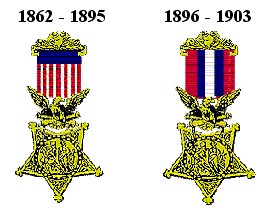
The Medal of Honor is the highest military decoration awarded by the United States. It is awarded "for conspicuous gallantry and intrepidity at the risk of life, above and beyond the call of duty, in actual combat against an armed enemy force." Since it was first awarded during the Civil War, the medal has been awarded 3,460 times, most recently in 2005. There were 23 Medal of Honor awarded to the Buffalo Soldiers during the Indian and the Spanish-American Wars.

9th Cavalry Medal of Honor Recipients

1. Sgt. Thomas Boyne – C Troop; Victorio Campaign, 1879
2. Pvt. John Denny – C Troop; Victorio Campaign, 1879
3. Cpl. Clinton Greaves – C Troop; Apache Campaign, 1877
4. Pvt. Henry Johnson – K Troop; Ute Campaign, 1879
5. Sgt. George Jordan – K Troop; Victorio Campaign, 1879
6. Sgt. Thomas Shaw – K Troop; Apache Campaign, 1881
7. Sgt. Emanuel Stance – F Troop; Texas, 1870
8. Sgt. Augustus Walley – E Troop; Apache Campaign, 1881
9. 1st Sgt. Moses Williams – I Troop; Apache Campaign, 1890
10. Cpl. William O. Wilson – I Troop; Pine Ridge Campaign, 1890
11. Sgt. Brent Woods – B Troop; Apache Campaign, 1881

10th Cavalry Medal of Honor Recipients

12. Sgt. Mjr. Edward L. Baker, Jr. – Spanish-American War, 1898
13. Pvt. Dennis Bell – H Troop; Spanish-American War, 1898
14. Pvt. Fitz Lee – M Troop; Spanish-American War, 1898
15. Sgt. William McBryar – K Troop; Apache Campaign, 1890
16. Cpl. William Tompkins – B Troop; Paymaster Escort, 1889
17. Pvt. George H. Wanton – M Troop; Spanish-American War 1898

24th Infantry Medal of Honor Recipients

18. Sgt. Benjamin Brown – C Troop; Paymaster Escort, 1889
19. Cpl. Isaiah Mays – B Troop; Paymaster Escort, 1889

Seminole Negro Indian Scouts Medal of Honor Recipients

20. Pvt. Pompey Factor – 24th Infantry; Staked Plans Expedition, 1875
21. Pvt. Adam Paine – 24th Infantry; Comanche Campaign, 1874
22. Trumpeter Isaac Payne – 24th Infantry; Staked Plans Expedition, 1875
23. Sgt. John Ward – 24th Infantry; Staked Plains Expedition, 1875

There are four other names that every Trooper should know. They may not be Medal of Honor recipients but many would consider them just as deserving for what they had to endure. Thirteen Black cadets matriculated at West Point between 1865 and 1915. Only three of them graduated. They were not so much hazed as ostracized. The treatment they received at West Point was shameful. After the first three had graduated from West Point, it would not be until 1936 that another Black cadet would graduate from the military academy.

They were:

• Lt. Henry O. Flipper – Graduated 1877
• Lt James H. Alexander – Graduated 1887
• Lt. Charles Young – Graduated 1889
• Lt. Benjamin O. Davis Jr. – Graduated 1936

For more information on these Medal of Honor recipients refer to Frank N. Schubert’s book “Black Valor – Buffalo Soldiers and the Medal of Honor, 1870 – 1898.”

Trooper Ron Jones

Formation of the Buffalo Soldier Regiments

I guess the best place to start would be at the beginning.

On July 28, 1866 the Thirty-Ninth Congress passed into law a provision that allowed Black men to serve in the United States Army during peace time. This was the first time in our nation’s history that such a thing was even possible. “An Act to increase and fix the Military Peace establishment of the United States” made it all possible. It reads as follows:

“Be it enacted by the Senate and House of Representatives of the United States of America in Congress assembled, That the military peace establishment of the United States shall hereafter consist of five regiments of artillery, ten regiments of cavalry, forty-five regiments of infantry, the professors and corps of cadets of the United States Military Academy, and such other forces as shall be provided for by this act, to be known as the Army of the United States.”

Section Three of the act went on to say: “And be it further enacted, That to the six regiments of cavalry now in service there shall be added four regiments, two of which shall be composed of "Colored" men, having the same organization as is now provided by law for cavalry regiments…” Those four additional cavalry regiments were the 7th, 8th, 9th, and 10th regiments. It was the 9th and 10th cavalries that were “composed of Colored men” and who spent the next 30 years serving in the Western territories where they were named Buffalo Soldiers by the Plaines Indians who engaged them in battle.

Section Four of the act outlined the infantry as follows: “And be it further enacted, That the forty-five regiments of infantry provided for by this act shall consist of the first ten regiments, of ten companies each, now in service; of twenty-seven regiments, of ten companies each, to be formed by adding two companies to each battalion of the remaining nine regiments; and of eight new regiments, of ten companies each, four regiments of which shall be composed of "Colored" men and four regiments of ten companies each to be raised and officered as hereinafter provided for...” The four infantry regiments that were "composed of Colored men" were the 38th, 39th, 40th and 41st regiments. In 1869 the 38th and 41st infantry regiments were reorganized to form the 24th infantry regiment and the 39th and 40th infantry regiments were reorganized to form the 25th infantry regiment, together all four regiments (the 9th & 10th Cavalries and the 24th & 25th Infantries) made a name for themselves while serving out west.

The general view at the time, of these “Colored” troops, was best captured by Lt. Grothe Hutcheson Adjutant 9th U.S. Cavalry. “The men knew nothing, and the non-commissioned officers but little more. From the very circumstances of their preceding life it could not be otherwise. They had no independence, no self-reliance, not a thought except for the present, and were filled with superstition. To make soldiers of, such material was, at that time, considered more of an experiment than as a fixed principle.” An experiment… That’s exactly what it was, but an experiment that exceeded all expectations. With their Seminole Negro Indian Scouts included these “Colored” regiments had 23 individuals earn the Medal of Honor. While the 9th and 10th Cavalry Regiments made up just 20% of the mounted regiments in the U.S. Army, and were often stationed at very remote locations, they managed to be involved in over 140 Indian engagements.

On July 28th, 2006 we celebrated the 140th Anniversary of the formation of the United States Army‘s six Black Regiments, who were nicknamed Buffalo Soldiers. I’d like to add that every minority serving in the military today, including women, owe a vote of thanks to the Buffalo Soldiers, who were the first and who opened the ‘door of opportunity’ so the rest of us could serve in the U.S. military.

Thank You – Buffalo Soldiers!
Trooper Ron Jones – Vietnam Vet – 12 years U.S. Navy,
Submarine Service (Nuclear)

Buffalo Soldiers

This Blog will be used to educate, inform and entertain you with information about the little known history of a group of U.S. Army regiments who were nicknamed, "Buffalo Soldiers." Who these men were and what their contributions to the growth and expansion of the United States was, will be highlighted in future Blogs.

For now, I'm just trying to settle into the Blogging concept and hope I can do these gentlemen's contribution to America's History proper justice.

Trooper Ron Jones