A Moment in History

By Adrian O' Connor & Trooper Houston Wedlock
In 1913, the Buffalo Soldiers Came to Winchester
Their band played “Dixie.”
Ninety-six years ago this summer, on the morning of July 19, 1913, troopers of the 10th U.S. Cavalry, more than 700 strong and led by their regimental band, rode into Winchester.
As the horsemen displayed their prowess in the saddle, the unit’s 28 musicians warmed the hearts of the local residents who lined Main (now Loudoun) Street by playing the tune most associated with the cause of Southern independence.
That this scene was touched by a certain undeniable irony is evident in the identity of the troopers. Though commanded by white officers, the 10th Cavalry was, in its rank and file, an all-black regiment.
Many were the sons of freed slaves. Others were descendants of black Civil War veterans. All were known by the name given in honor by the Cheyenne during the Indian Wars — “Buffalo Soldiers.”
That unusual demonstration in the streets of Winchester — black musicians playing the popular Confederate anthem in a Southern town — was but a foreshadowing of a unique, albeit largely unknown, episode in the history of the northern Shenandoah Valley.
For two months that summer, a sprawling “camp of cavalry instruction” occupied 1,200 acres along the Front Royal Road.
For the Buffalo Soldiers of the 10th Cavalry, the road to “Dixie” — and the streets of Winchester — began more than a month and 706 miles earlier, at Fort Ethan Allen, Vt.
Hard as it may be to imagine now, the U.S. War Department would often hold peacetime maneuvers in locales far removed from its forts, or bases of operations.
Such was the case in 1913 when the 10th Cavalry left Fort Ethan Allen for a handpicked site in Frederick County.
To move the largest cavalry command the Valley would see since Union Gen. Philip Sheridan put the Shenandoah to the torch in 1864 was a considerable undertaking.
More than 700 men — 680 troopers and 30 officers — left Vermont on June 16 with 800 horses and mules and 36 wagons stocked with provisions.
The line of march led the 10th through such cities and towns as Burlington and Hubbardton in Vermont and Saratoga Springs, Schenectady, Cobleskill, Oneonta, and Sidney in New York.
In Winchester, the regiment would be joined by the 11th Cavalry, based in Fort Oglethorpe, Ga., and selected troops from the 15th Cavalry, stationed at Fort Sheridan, Ill. — all-white regiments both.
The 10th’s journey south was largely uneventful, save for an incident in Carlisle, Pa., in which a young woman said a black trooper had assaulted her and knocked her escort unconscious. However, after two examinations of the entire command did not yield a positive identification of the assailant, it was concluded that a cavalryman was not to blame for the crime.
By July 17, the Buffalo Soldiers, averaging a crisp 23 miles a day, had reached Williamsport, Md., where they camped for the night. The next day found them at Darkesville, W.Va., south of Martinsburg, their last stop before establishing their bivouac outside Winchester.
When the Buffalo Soldiers stepped proudly on parade through the city on July 19, the lion’s share of the 15th Cavalry was already in camp, having arrived the day before.
By nightfall of July 20, other detachments from the 15th made it to the camp on the high, rolling terrain blessed with a perfect view of the distant Blue Ridge. (The site is roughly five miles down U.S. 522 from the Interstate 81/U.S. 50 interchange, across from the aptly named Fort View Motel).
Troops B, C, and D had spent two days at the Antietam battlefield in Maryland; another group, accompanied by a battery of field artillery, would come rolling into town on Baltimore & Ohio railroad cars from Fort Sheridan.
This swelled the ranks to roughly 2,100 men.
Two more troops, one each from the 11th and 15th regiments, would come late the following week, pushing the total to nearly 2,500.
In charge of the camp was Col. Cunliffe H. Murray of the 12th Cavalry. Leading the Buffalo Soldiers was a relatively new commander, Col. John C. Gresham, who had replaced Col. Thaddeus W. Jones, a veteran of 40 years in the saddle, the previous October.
As expected, a “state of chaos and confusion” reigned in those early hours of camp, as The Star noted in its columns of July 21. But order eventually prevailed.
A field hospital quickly took shape, as did a post exchange and a post office.
However, the Army could do little to prevent the hurlyburly on the Front Royal Road outside the camp.
A swarm of vendors had set up shanties selling candy, fruit, cakes, and soft drinks to the throngs of visitors who flocked to the site to observe what the Army had in store for the next two months.
Over that period, the assembled cavalrymen would engage in tactical maneuvers, simulated war games, field exercises, and horsemanship and saber competitions.
As Col. Murray told The Star, the real instruction would begin at 7 a.m. on Wednesday, July 23.
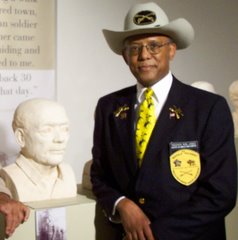
Houston Wedlock is not a man given to craziness.
Such a state of mind hardly becomes a person of his stature. A Green Beret, Wedlock retired from the Army in 1974 after 20 years of service — with 498 airplane jumps and two tours of Vietnam under his belt.
And yet, upon discovering that the Buffalo Soldiers had actually bivouacked near Winchester, he said, “I went crazy.”
But for good reason.
Now a resident of Columbia, Md., Wedlock, 66 (at the time of this original article), was born and raised in the Clarke County community of White Post, just a short gallop from the site of that “camp of cavalry instruction” on the Front Royal Road.
“I never knew they were here,” he said. “This was home, and this is a nice piece of history for the town.”
And “a nice piece of history” for a re-enactor and member of the 9th and 10th Horse Cavalry Association to pursue.
Together with Air Force veteran Stanley Lawson, another native of White Post, and Isaac Prentice of Fort Washington, Md., Wedlock formed the “Research Re-enactors” back in the ’90s.
The group is dedicated to all things Buffalo Soldier as well as to the history of the four historically all-black regiments — the 9th and 10th Cavalry and the 24th and 25th U.S. Infantry — known collectively by that name.
The three men — all retired or, in Wedlock’s case, semi-retired — couple their interest in history with a devotion to community outreach.
Donning distinctive period dress, they’ve brought the story of the Buffalo Soldiers to schools, churches, and federal agencies. They’ve done television shows and participated in parades and marches all over the Washington, D.C., area and beyond — particularly during February, Black History Month.
But, as Prentice points out, what they strive to teach is “not black history, but American history.”
“These men,” he said, “were Americans. Their stories are American stories.”
Prentice, through his uniform, has a particular story to tell — that of Capt. Henry Vinton Plummer, the first black chaplain in the U.S. Army after Reconstruction.
Born a slave in Prince George’s County, Md., in 1844, Plummer received an appointment to the 9th Cavalry in 1884 and served as chaplain to that unit for the ensuing 10 years.
Wedlock and Lawson, meanwhile, appear in generic cavalry uniforms, circa 1885. Wedlock wears the mounted uniform of a first sergeant; Lawson sports a sergeant’s field uniform, complete with the distinctive yellow trooper’s gloves.
“It’s an interesting hobby,” Wedlock said. “We’ve been to so many schools in [the Winchester] area, but we couldnever tell the kids the Buffalo Soldiers were here. Now we can.”
Toward that informational end, Wedlock has immersed himself in the lore of that 1913 venture.
Using the records on file at Carlisle Barracks (the U.S. Army War College in Carlisle, Pa.), he has meticulously tracked the route of the 10th Cavalry from Fort Ethan Allen to Winchester.
Through his research, Wedlock has a theory as to why Winchester was chosen as the site for this camp.
The northern Valley, he says, was centrally located for the three regiments that would participate in the camp of instruction. What’s more, it was close enough for officials of the War Department (Secretary Lindley M. Garrison, for example) and the central command (Army Chief of Staff Gen. Leonard Wood) to come from Washington to review the troops.
From a historical perspective, Wedlock notices too a certain symmetry in the selection of Winchester. A goodly number of Buffalo Soldiers, he says, hailed from this general area.
Lawson, for instance, likes to point out that Trooper (Pvt.) Charles Davis was reared in White Post, where the house in which he grew up still stands. Davis, however, did not take part in the 1913 camp, as he was a member of the 9th Cavalry.
That Davis’ memory lives on can be attributed not merely to Wedlock and Lawson. His kinfolk — in particular, three generations of Ford men, all named Edwin James — still reside in the Valley.
In fact, Edwin James Ford Jr. of Winchester happily provided the photos of his great uncle that appear with this article.
The memories of other Buffalo Soldiers remain fresh, largely due to the re-enactors’ joyful efforts to keep the legacy before the public.
Wedlock, for example, clearly relishes his role as historian and story-teller. One of his more interesting tales is that of Cathay Williams, who, as William Cathey, disguised herself as a man and joined the BuffaloSoldiers shortly after the Civil War.
Tall and slender at 5 foot 9, she managed to remain a trooper for two years (18661868) without being discovered.
Even Cathay, said Wedlock, has a northern Valley connection, having served as cook and washerwoman to the staff of Gen. Phil Sheridan when it was based in Winchester during the climactic Valley Campaign of 1864.
The 10th U.S. Cavalry was commissioned and activated at Fort Leavenworth, Kan., on July 28, 1866.
It did not take long for the black troopers — freed slaves and Civil War veterans — to make a name for themselves.
While patrolling the Kansas Pacific Railroad in the summer of 1867, the 10th, commanded by Col. Benjamin H. Grierson, twice engaged larger bands of Cheyenne in sharp combat.
It was after these clashes that the Cheyenne dubbedtheir blue-clad foe “Buffalo Soldiers” — for their skin color, for their short, wooly hair, and, most of all, for their fierceness in battle.
The appellation soon became a badge of honor. The10th, in time, included a buffalo figure as part of its insignia.
Later that year, riding with Sheridan, the 10th vigorously pursued — and eventually captured — the famous Cheyenne leader Black Kettle and his warrior band through a blinding snowstorm. This episode added to the regiment’s growing legend.
Though the 10th would be involved in 177 separate engagements over the course of the protracted Indian Wars, much of their duty was considerably more prosaic.
In addition to fighting Indians, the Buffalo Soldiersscouted and patrolled a 34,420-mile area of the Western plains, laid hundreds of miles of new railroad track, put up new telegraph lines, protected mail coaches, arrested cattle rustlers and bandits, and escorted settlers, railroad crews, and even herds of cattle to their respective destinations in the West.
Together with the other allblack horse regiment, the 9th,the Buffalo Soldiers of the 10th comprised 20 percent of the cavalry stationed in the West.
During the Indian Wars, no less than 18 BuffaloSoldiers received the Medal of Honor, with Sgt. Emanuel Stance being the first such honoree.
What’s more, the black regiments boasted the lowest rate of desertion — 4 percent — in the Army. Overall, this rate ran as high as 25 percent.
Nonetheless, certain officers — Gen. George Armstrong Custer being the most noteworthy — were either reluctant or outright refused to place the black troopers under their command.
A notable exception was future General of the Armies John J. “Black Jack” Pershing, who, early in his career, was a junior officer in the 10th. In fact, his nickname can be traced to those days in the 1890s when he led black troops.
Late in the Indian Wars, the 10th was instrumental in chasing down the two renegade Apache chieftains, Victorio and Geronimo. Then, roughly a decade later, they fought heroically alongside Teddy Roosevelt and the Rough Riders in their fabled charge up San Juan Hill during the Spanish-American War.
In 1909, in response to allegations of discrimination — it was said the black regiments were given the worst billets even when they requested better — the Army decided to move the 10th east to the relative comfort of Fort Ethan Allen with its indoor riding hall and superbly equipped gymnasium.
And it was from there, of course, that the 10th left on its 706-mile trek to Winchester and the “camp of cavalry instruction” on the Front Royal Road.
That the troopers of the 10th, 11th, and 15th Cavalry quickly became a part of the Winchester community during their two-month stay can be evidenced on the pages of The Star.
For example, the cavalry officers sponsored a dance (Aug. 4); the precision-riding troopers were the hit of a talent show to benefit the Winchester hospital (Aug. 20); and the camp opened its tent flaps to the public for a “moving pictures” program (Aug. 30) and then for a minstrel show (Sept. 6).
The highlight of their immersion in local affairs came during the second week of September when, as part of the Winchester Fair, the Army horse soldiers displayed their talents in cavalry drills and races to crowds numbering — in The Star’s estimate — as high as 12,000 people.
To be sure, the camp did experience its share of untoward bumps during those two months in the Valley.
The local constabulary seized a stash of illegal liquor on Aug. 11; “sundry offenses” by troopers necessitated a series of courts-martial on Aug. 19; and, on Sept. 5, a lovesick trooper from the 11th Cavalry — Ernest Baker — committed suicide when his fianceé “threw him over.”
However, the incident that caused the most stir among the local populace came early in the Army’s prolonged visit.
On July 25, Frederick County Sheriff Luther Pannett, with the cooperation of Lt. Arthur Conrad of the 10th Cavalry, arrested two white women in a tent at the edge of camp.
The women, said to be French-Canadian, were caught in the company of six black troopers, all of whom escaped in the chaotic raid. One, however, cut himself severely on a wire fence, necessitating a trip to the Army’s field hospital.
It was not until four days later that police in Harrisburg, Pa., nabbed the raid’s foremost target — a mulatto named Samuel Franklin allegedly engaged in the white slave trade.
For the most part, the Army earned praise for its exemplary conduct. In fact, Winchester Police Chief M.A. Doran saw fit to respond to a Baltimore Sun article of July 27 that stated black troopers were misbehaving on the streets of Winchester, to the point of pushing residents off the sidewalks.
Quickly dismissing the allegations, Doran informed Col. Gresham, commander of the 10th, that “there has not been a single complaint regarding the conduct of either the white or colored troopers, but on the other hand they have conducted themselves at all times in a quiet and orderly fashion.”
In late September, the big brass — Secretary of War Garrison and Army Chief of Staff Gen. Wood — visited Winchester to survey the camp and review the troops.
Then, beginning on the evening of Sept. 29, the three regiments commenced breaking camp.
By 8 a.m. on Sept. 30, they were gone.
The 10th Cavalry made its way to Roslyn, across the Potomac River from Washington, where, in the second week of October, it conducted exercises and passed in review before President Woodrow Wilson.
On Oct. 11, the regiment left by train for Fort Ethan Allen.
The 10th’s days in Vermont, however, were shortlived. In November and December of 1913, the BuffaloSoldiers left the comfort of the fort and returned to the Southwest.
Stationed at Fort Huachuca in Arizona, they patrolled the volatile Mexican border, often crossing into Mexico to pursue bandits and gun-runners from that politically unstable nation.
Later, the Buffalo Soldiers would fight together in both world wars and in Korea.
After the armed forces were desegregated in 1952, soldiers from these previously all-black regiments were absorbed into other units.
Though the Buffalo Soldiers are now consigned to history, the 9th and 10th Cavalry live on, reincarnated as regiments of armor. The 24th Infantry, the last all-black regiment to see action (in Korea), remains on the Army’s rolls; the 25th Infantry, however, was disbanded.
While it’s safe to assume that those rolling hills of southeastern Frederick County will never again feel the synchronized tumult of pounding hooves or hear the lonesome sounds of morning reveille or nightly “Taps,” that very ground may one day witness the return of horses, mules, and excited riders.
That is, if Houston Wedlock can somehow turn a dream into reality.
Only this time, the horsemen, as it were, will not be the seasoned troopers of old, but children, youths whose lives have been fractured by neglect and abuse.
Shortly after retiring from his second career, as a regional administrator for Preston Trucking Co., Wedlock became involved with Vision Quest, a nationwide program for at-risk youth based in Tucson, Ariz.
These children are adjudicated to Vision Quest’s care from juvenile courts. For the past 29 years, the organization, which receives funding from individual states, has employed a rigorous program grounded in military discipline to help these youngsters attain a proper path in life.
An unusual feature of the program — and one near and dear to Wedlock’s heart — gives each child the responsibility of caring for an animal, usually a horse. Regionally, Vision Quest has a camp in Pennsylvania, near South Mountain, where these animals are quartered.
“We try to keep the kids busy,” Wedlock said. “We show them that they should give something back [to the community].”
Wedlock’s dream, therefore, is to bring his Vision Quest youth to Frederick County and re-create the encampment of 1913 on the very property where theBuffalo Soldiers once rode.
This is hardly an idle “vision” — or “quest,” for that matter. He has already done a similar re-enactment, based on the history of Custer’s 7th Cavalry, in Montana.
Wedlock originally hoped to put such an event together in years past, but work with Vision Quest kept him on the road virtually the entire summer.
But, guided by the spirit of the Buffalo Soldiers of yore, he has set his sights to the future, when on the anniversary of their arrival, he will celebrate, with the young troopers, when the rolling thunder of galloping steeds could be heard up and down the Front Royal Road.
Note: Slight edits were made to the article to update certain time lines. The photo of Trooper Wedlock was made available by the Vermont Area 9th & 10th (Horse) Cavalry Association. Vermont-Buffalo-Soldiers - Fort Ethan Allen