Fiddler’s Green
pause. Cavalrymen though are authorized to dismount, unsaddle and
This Blog is dedicated to the men who served in the segregated regiments of the 9th and 10th Cavalries and 24th and 25th Infantries from 1866 to 1951. The GLAAC newsletter "BUGLE CALL" is now archived at this blog. Look for post dated December 28, 2010 to find back issues of our newsletter.
“Yes, Joshua there still are Buffalo Soldiers.”
Dear Editor: I am a 3rd grader at the C.L.A.S. Charter School. This past October I dressed as a Buffalo Soldier for our Fall Festival. All my little friends told me that there were no more Buffalo Soldiers. I asked my mother and she said, “If you read it in the BUGLE CALL it’s so.” Please tell me the truth, are there still Buffalo Soldiers?
Joshua Sims
Los Angeles, CA.
Joshua, your little friends are wrong. They have been deprived by a lack of books, movies and programming that should be available to cover the rich history that is the Buffalo Soldiers. They have been affected by an institutionalized attempt to withhold the contributions of African Americans to the development, growth and protection of this great nation. They do not believe except [what] they see. They think that nothing can be which is not comprehensible by their little minds. All minds, Joshua, whether they be man’s or children’s, are little. In this great universe of ours man is a mere insect, an ant, in his intellect, as compared with the boundless world about him, as measured by the intelligence capable of grasping the whole of truth and knowledge.
Yes, Joshua, there still are Buffalo Soldiers. They exists as surely as devotion, unselfishness, generosity and love for this country exists, and you know that they abound and give to your life its highest beauty and joy. Alas! How different would the world be if there never were any Buffalo Soldiers? If would be as different as if there never was a Joshua. There would be no childlike faith then, no childlike curiosity and infinite imagination to make tolerable this existence. The eternal light with which childhood fills the world would be extinguished.
Without the Buffalo Soldiers there would be no Tuskegee Airmen, no Montfort Point Marines and no Triple Nickel Parachute Unit; there would be no Navajo Code Talkers or 442nd Regimental Combat Team, the most decorated regiment in the history of the United States armed forces and they were made up of Japanese Americans. Without the Buffalo Soldiers there would be no minorities or women in the military. The Buffalo Soldiers were the first minorities to serve in the regular peacetime military and they opened the door for all the minorities who came after them.
Joshua, the number of original Buffalo Soldiers gets smaller everyday. They are the last of our World War II and Korean War veterans. But even after the last one of them has gone, the Buffalo Soldiers will continue to exist. They will exist because of you Joshua and children like you. When you dress-up as a Buffalo Soldier you are helping to keep their memory alive. When your friends ask you who were the Buffalo Soldiers, and you’re able to tell their story; you are helping to keep their legacy going. And when people are able to read the truth about the Buffalo Soldiers in the BUGLE CALL, I am helping to educate an uninformed populace about the contributions of the Buffalo Soldiers and together Joshua, you and I will keep their memory alive.
Yes Joshua, because of you there will always be Buffalo Solders.
I want to thank the City of Inglewood for inviting us to be a part of their 28th Annual tribute to Dr. Martin Luther King Jr. Inglewood was one of the first cities in the nation to designate Dr. King's birthday a legal holiday. Congratulations Inglewood, the City of Champions.
Lest we forget:
I HAVE A DREAM
By: Dr. Martin Luther King Jr., August 28, 1963
Five score years ago, a great American, in whose symbolic shadow we stand, signed the Emancipation Proclamation. This momentous decree came as a great beacon light of hope to millions of Negro slaves who had been seared in the flames of withering injustice. It came as a joyous daybreak to end the long night of captivity. But one hundred years later, we must face the tragic fact that the Negro is still not free.
One hundred years later, the life of the Negro is still sadly crippled by the manacles of segregation and the chains of discrimination. One hundred years later, the Negro lives on a lonely island of poverty in the midst of a vast ocean of material prosperity. One hundred years later, the Negro is still languishing in the corners of American society and finds himself an exile in his own land.
So we have come here today to dramatize an appalling condition. In a sense we have come to our nation's capital to cash a check. When the architects of our republic wrote the magnificent words of the Constitution and the Declaration of Independence they were signing a promissory note to which every American was to fall heir.
This note was a promise that all men would be guaranteed the inalienable rights of life, liberty, nad the pursuit of happiness. It is obvious today that America has defaulted on this promissory note insofar as her citizens of color are concerned. Instead of honoring this sacred obligation, America has given the Negro people a bad check which has come back marked "insufficient funds." But we refuse to believe that the bank of justice is bankrupt. We refuse to believe that there are insufficient funds in the great vaults of opportunity of this nation.
So we have come to cash this check -- a check that will give us upon demand the riches of freedom and the security of justice. We have also come to this hallowed spot to remind America of the fierce urgency of now. This is no time to engage in the luxury of cooling off or to take the tranquilizing drug of gradualism. Now is the time to rise from the dark and desolate valley of segregation to the sunlit path of racial justice. Now is the time to open the doors of opportunity to all of God's children. Now is the time to lift our nation from the quicksands of racial injustice to the solid rock of brotherhood.
It would be fatal for the nation to overlook the urgency of the moment and to underestimate the determination of the Negro. This sweltering summer of the Negro's legitimate discontent will not pass until there is an invigorating autumn of freedom and equality. Nineteen sixty-three is not an end, but a beginning. Those who hope that the Negro needed to blow off steam and will now be content will have a rude awakening if the nation returns to business as usual. There will be neither rest nor tranquility in America until the Negro is granted his citizenship rights.
The whirlwinds of revolt will continue to shake the foundations of our nation until the bright day of justice emerges. But there is something that I must say to my people who stand on the warm threshold which leads into the palace of justice. In the process of gaining our rightful place we must not be guilty of wrongful deeds. Let us not seek to satisfy our thirst for freedom by drinking from the cup of bitterness and hatred.
We must forever conduct our struggle on the high plane of dignity and discipline. we must not allow our creative protest to degenerate into physical violence. Again and again we must rise to the majestic heights of meeting physical force with soul force.
The marvelous new militancy which has engulfed the Negro community must not lead us to distrust of all white people, for many of our white brothers, as evidenced by their presence here today, have come to realize that their destiny is tied up with our destiny and their freedom is inextricably bound to our freedom.
We cannot walk alone. And as we walk, we must make the pledge that we shall march ahead. We cannot turn back. There are those who are asking the devotees of civil rights, "When will you be satisfied?" we can never be satisfied as long as our bodies, heavy with the fatigue of travel, cannot gain lodging in the motels of the highways and the hotels of the cities. We cannot be satisfied as long as the Negro's basic mobility is from a smaller ghetto to a larger one. We can never be satisfied as long as a Negro in Mississippi cannot vote and a Negro in New York believes he has nothing for which to vote. No, no, we are not satisfied, and we will not be satisfied until justice rolls down like waters and righteousness like a mighty stream.
I am not unmindful that some of you have come here out of great trials and tribulations. Some of you have come fresh from narrow cells. Some of you have come from areas where your quest for freedom left you battered by the storms of persecution and staggered by the winds of police brutality. You have been the veterans of creative suffering. Continue to work with the faith that unearned suffering is redemptive.
Go back to Mississippi, go back to Alabama, go back to Georgia, go back to Louisiana, go back to the slums and ghettos of our northern cities, knowing that somehow this situation can and will be changed. Let us not wallow in the valley of despair. I say to you today, my friends, that in spite of the difficulties and frustrations of the moment, I still have a dream. It is a dream deeply rooted in the American dream.
I have a dream that one day this nation will rise up and live out the true meaning of its creed: "We hold these truths to be self-evident: that all men are created equal." I have a dream that one day on the red hills of Georgia the sons of former slaves and the sons of former slaveowners will be able to sit down together at a table of brotherhood. I have a dream that one day even the state of Mississippi, a desert state, sweltering with the heat of injustice and oppression, will be transformed into an oasis of freedom and justice. I have a dream that my four children will one day live in a nation where they will not be judged by the color of their skin but by the content of their character. I have a dream today.
I have a dream that one day the state of Alabama, whose governor's lips are presently dripping with the words of interposition and nullification, will be transformed into a situation where little black boys and black girls will be able to join hands with little white boys and white girls and walk together as sisters and brothers. I have a dream today. I have a dream that one day every valley shall be exalted, every hill and mountain shall be made low, the rough places will be made plain, and the crooked places will be made straight, and the glory of the Lord shall be revealed, and all flesh shall see it together. This is our hope. This is the faith with which I return to the South. With this faith we will be able to hew our of the mountain of despair a stone of hope. With this faith we will be able to transform the jangling discords of our nation into a beautiful symphony of brotherhood. With this faith we will be able to work together, to pray together, to struggle together, to go to jail together, to stand up for freedom together, knowing that we will be free one day.
This will be the day when all of God's children will be able to sing with a new meaning, "My country, 'tis of thee, sweet land of liberty, of thee I sing. Land where my fathers died, land of the pilgrim's pride, from every mountainside, let freedom ring." And if America is to be a great nation, this must become true. So let freedom ring from the prodigious hilltops of New Hampshire. Let freedom ring from the mighty mountains of New York. Let freedom ring from the heightening Alleghenies of Pennsylvania! Let freedom ring from the snowcapped Rockies of Colorado! Let freedom ring from the curvaceous peaks of California! But not only that; let freedom ring from Stone Mountain of Georgia! Let freedom ring from Lookout Mountain of Tennessee! Let freedom ring from every hill and every molehill of Mississippi. From every mountainside, let freedom ring.
When we let freedom ring, when we let it ring from every village and every hamlet, from every state and every city, we will be able to speed up that day when all of God's children, black men and white men, Jews and Gentiles, Protestants and Catholics, will be able to join hands and sing in the words of the old Negro spiritual, "Free at last! free at last! thank God Almighty, we are free at last!"
I’ve stood at the entrance of St. Patrick’s Cathedral in New York City. It is an architectural wonder with beautiful statuary and priceless works of art. There are many altars within the cathedral adorned in gold and jewels. When I asked, “What is this place?” I was told, this is God’s house! As a child, I’ve camped alongside the King’s River and I’ve slept outdoors at the foot of a Giant Sequoia Redwood in Sequoia National Forest; looked up at the sky at night and saw more stars than I have ever seen in my entire life. When I asked, “What is this place?” I was told, this is God’s home!
In God’s house there is a golden chalice, used for the consecration and distribution of sacramental wine and it is kept on an altar, but in God’s home I’ve stood on the snow-covered-rim of Crater Lake and seen water so blue and so pure that I knew ...this is where God dips his cup.
This month your local PBS stations broadcasted a six part Ken Burns series titled: “The National Parks: America’s Best Idea.” The Buffalo Soldiers’ contributions to our National Parks were highlighted in the series and we are very thankful to Ken Burns for the recognition, but this series goes well beyond the contribution of any individual(s). There is a synergy to the efforts of the men and women highlighted in this series and it is their combined and sustained effort that has made our National Parks and the National Park Service what they are today.
If you haven’t seen this series check with you local PBS station or request it. If you can afford it, buy it. You will be a better person for the experience. This series took me back to my youth, traveling to our National Monuments and camping in our National Parks. FYI, just one percent of the visitors to Yosemite National Park are Black. That’s a Fact!
Sometimes we have to step out of God’s house and into God’s home to realize the awesome responsibility we have, not just to our families, our church families and to each other, but to the land and the water and to this planet as a whole; for this isn’t just God’s home, it’s our home too!
A Buffalo Soldier Died Today!
A Buffalo Soldier died today, and when he did a mother and a father lost a son; siblings lost a brother; nieces and nephews lost an uncle. His wife lost her husband; the community lost a neighbor and his associates lost a friend. Now you might ask me; Trooper Jones, isn’t that basically what happens anytime someone dies? Yes it is! But this was a Buffalo Soldier. We as a people lost a role model and this Nation lost another hero.
A role model and a hero. Think about these words; let them roll around in your mind until you’ve created a concept of understanding about their definitions, their meaning and what it truly takes to be, a role model and a hero. Now think of someone you know personally who is your role model or your hero. You’ll know that you have reached the correct understanding when you begin to feel a tingle that starts at the base of your neck and runs down your spine with a shiver that causes your shoulders to do the shimmy shake, and you whisper, “Oh my, I know someone like that!”
Basically, a role model is someone who is worthy of imitation. Alright, that makes sense. But how does one become worthy? Well, a worthy person is someone who has “qualities or abilities that merit recognition in some way.” Merit? How does someone merit anything? As it turns out merit is the quality of being deserving. You become deserving by your actions. In other words, you “earn” it.
Okay, we have arrived at the base word that I think we can all understand. Earn! If we do our chores we earn playtime, if we do our homework we earn good grades and if we do our job we earn a salary. There are no shortcuts to earning. You have to do the time!
A role model is someone who has done the time in such a way, that they have become deserving... they merit... they are so worthy of our respect and admiration that we view them as a Role Model.
A Buffalo Soldier died today! His name was: Trooper Robert L. McDaniel - WWII Veteran, U.S. Army - 4th Calvary Brigade, 2d Calvary Division, 9th Calvary Regiment. He was one of the few remaining original Buffalo Soldiers from a bygone era. There aren’t that many of them left. You owe it to yourself to get to know a Buffalo Soldier, before they are all gone. I knew one, and now he’s gone!

Did You Know?
There is a grassroots effort in place to have Colonel Young, posthumously promoted to Brigadier General.
I first became aware of this project when Trooper Yolanda Williams (President of the Inland Empire Buffalo Soldier Heritage Association) asked me to participate in a letter writing campaign, to my State and National Congressional and Senatorial Representatives. Since that introduction, from Trooper Williams, there has been a ground swell of interest in this project and the Los Banos Chamber of Commerce and the Los Banos Chapter of the NINTH & TENTH (HORSE) CAVALRY ASSOCIATION, have taken a proactive roll to make sure this effort comes to fruition.
In 2007, when Trooper Bobby McDonald ran for National President of the 9th & 10th (Horse) Cavalry Association, his campaign slogan was; “Preserving, Promoting & Perpetuating the history of the Buffalo Soldiers”. That is our, Millstone! As members of this great organization we have a moral responsibility to the OBS (Original Buffalo Soldiers); those that have gone on to Fiddler’s Green and to those Originals who are still with us. We owe them our dedication and our trust that we will always attempt to do the right thing. If an organization or a group of organizations are trying to both figuratively and literally Promote the accomplishments of Col. Young, then it is our responsibility to get onboard and help guarantee the success of this endeavor.
I wish to salute to efforts of: Trooper David Ofwono, President of the Los Banos Buffalo Soldiers, along with Troopers: Geneva Brett, Kevin Craig, Jeff Periera, Phil Colman and Aimbrell Shanks, all Board members of the Los Banos Buffalo Soldiers - NINTH & TENTH (HORSE) CAVALRY ASSOCIATION; ...I salute them for rolling up their sleeves and getting involved.
How do we get involved?
The Los Banos Buffalo Soldiers Chapter has made it very easy for any of us who want to help and that should be anyone who is reading this article. Just go to their website:
www.losbanosbuffalosoldiers.org
Click on the “Promote Charles Young to General” link, and sign the petition. That’s all there is to it. Signing the petition is a three of four step process. Make sure you go through all the steps in order for your entry to be registered. I’ve already signed, just look for Trooper Ron Jones, California... I’ll be looking for your entry.
A Moment in History

By Adrian O' Connor & Trooper Houston Wedlock
In 1913, the Buffalo Soldiers Came to Winchester
Their band played “Dixie.”
Ninety-six years ago this summer, on the morning of July 19, 1913, troopers of the 10th U.S. Cavalry, more than 700 strong and led by their regimental band, rode into Winchester.
As the horsemen displayed their prowess in the saddle, the unit’s 28 musicians warmed the hearts of the local residents who lined Main (now Loudoun) Street by playing the tune most associated with the cause of Southern independence.
That this scene was touched by a certain undeniable irony is evident in the identity of the troopers. Though commanded by white officers, the 10th Cavalry was, in its rank and file, an all-black regiment.
Many were the sons of freed slaves. Others were descendants of black Civil War veterans. All were known by the name given in honor by the Cheyenne during the Indian Wars — “Buffalo Soldiers.”
That unusual demonstration in the streets of Winchester — black musicians playing the popular Confederate anthem in a Southern town — was but a foreshadowing of a unique, albeit largely unknown, episode in the history of the northern Shenandoah Valley.
For two months that summer, a sprawling “camp of cavalry instruction” occupied 1,200 acres along the Front Royal Road.
For the Buffalo Soldiers of the 10th Cavalry, the road to “Dixie” — and the streets of Winchester — began more than a month and 706 miles earlier, at Fort Ethan Allen, Vt.
Hard as it may be to imagine now, the U.S. War Department would often hold peacetime maneuvers in locales far removed from its forts, or bases of operations.
Such was the case in 1913 when the 10th Cavalry left Fort Ethan Allen for a handpicked site in Frederick County.
To move the largest cavalry command the Valley would see since Union Gen. Philip Sheridan put the Shenandoah to the torch in 1864 was a considerable undertaking.
More than 700 men — 680 troopers and 30 officers — left Vermont on June 16 with 800 horses and mules and 36 wagons stocked with provisions.
The line of march led the 10th through such cities and towns as Burlington and Hubbardton in Vermont and Saratoga Springs, Schenectady, Cobleskill, Oneonta, and Sidney in New York.
In Winchester, the regiment would be joined by the 11th Cavalry, based in Fort Oglethorpe, Ga., and selected troops from the 15th Cavalry, stationed at Fort Sheridan, Ill. — all-white regiments both.
The 10th’s journey south was largely uneventful, save for an incident in Carlisle, Pa., in which a young woman said a black trooper had assaulted her and knocked her escort unconscious. However, after two examinations of the entire command did not yield a positive identification of the assailant, it was concluded that a cavalryman was not to blame for the crime.
By July 17, the Buffalo Soldiers, averaging a crisp 23 miles a day, had reached Williamsport, Md., where they camped for the night. The next day found them at Darkesville, W.Va., south of Martinsburg, their last stop before establishing their bivouac outside Winchester.
When the Buffalo Soldiers stepped proudly on parade through the city on July 19, the lion’s share of the 15th Cavalry was already in camp, having arrived the day before.
By nightfall of July 20, other detachments from the 15th made it to the camp on the high, rolling terrain blessed with a perfect view of the distant Blue Ridge. (The site is roughly five miles down U.S. 522 from the Interstate 81/U.S. 50 interchange, across from the aptly named Fort View Motel).
Troops B, C, and D had spent two days at the Antietam battlefield in Maryland; another group, accompanied by a battery of field artillery, would come rolling into town on Baltimore & Ohio railroad cars from Fort Sheridan.
This swelled the ranks to roughly 2,100 men.
Two more troops, one each from the 11th and 15th regiments, would come late the following week, pushing the total to nearly 2,500.
In charge of the camp was Col. Cunliffe H. Murray of the 12th Cavalry. Leading the Buffalo Soldiers was a relatively new commander, Col. John C. Gresham, who had replaced Col. Thaddeus W. Jones, a veteran of 40 years in the saddle, the previous October.
As expected, a “state of chaos and confusion” reigned in those early hours of camp, as The Star noted in its columns of July 21. But order eventually prevailed.
A field hospital quickly took shape, as did a post exchange and a post office.
However, the Army could do little to prevent the hurlyburly on the Front Royal Road outside the camp.
A swarm of vendors had set up shanties selling candy, fruit, cakes, and soft drinks to the throngs of visitors who flocked to the site to observe what the Army had in store for the next two months.
Over that period, the assembled cavalrymen would engage in tactical maneuvers, simulated war games, field exercises, and horsemanship and saber competitions.
As Col. Murray told The Star, the real instruction would begin at 7 a.m. on Wednesday, July 23.
Houston Wedlock is not a man given to craziness.
Such a state of mind hardly becomes a person of his stature. A Green Beret, Wedlock retired from the Army in 1974 after 20 years of service — with 498 airplane jumps and two tours of Vietnam under his belt.
And yet, upon discovering that the Buffalo Soldiers had actually bivouacked near Winchester, he said, “I went crazy.”
But for good reason.
Now a resident of Columbia, Md., Wedlock, 66 (at the time of this original article), was born and raised in the Clarke County community of White Post, just a short gallop from the site of that “camp of cavalry instruction” on the Front Royal Road.
“I never knew they were here,” he said. “This was home, and this is a nice piece of history for the town.”
And “a nice piece of history” for a re-enactor and member of the 9th and 10th Horse Cavalry Association to pursue.
Together with Air Force veteran Stanley Lawson, another native of White Post, and Isaac Prentice of Fort Washington, Md., Wedlock formed the “Research Re-enactors” back in the ’90s.
The group is dedicated to all things Buffalo Soldier as well as to the history of the four historically all-black regiments — the 9th and 10th Cavalry and the 24th and 25th U.S. Infantry — known collectively by that name.
The three men — all retired or, in Wedlock’s case, semi-retired — couple their interest in history with a devotion to community outreach.
Donning distinctive period dress, they’ve brought the story of the Buffalo Soldiers to schools, churches, and federal agencies. They’ve done television shows and participated in parades and marches all over the Washington, D.C., area and beyond — particularly during February, Black History Month.
But, as Prentice points out, what they strive to teach is “not black history, but American history.”
“These men,” he said, “were Americans. Their stories are American stories.”
Prentice, through his uniform, has a particular story to tell — that of Capt. Henry Vinton Plummer, the first black chaplain in the U.S. Army after Reconstruction.
Born a slave in Prince George’s County, Md., in 1844, Plummer received an appointment to the 9th Cavalry in 1884 and served as chaplain to that unit for the ensuing 10 years.
Wedlock and Lawson, meanwhile, appear in generic cavalry uniforms, circa 1885. Wedlock wears the mounted uniform of a first sergeant; Lawson sports a sergeant’s field uniform, complete with the distinctive yellow trooper’s gloves.
“It’s an interesting hobby,” Wedlock said. “We’ve been to so many schools in [the Winchester] area, but we couldnever tell the kids the Buffalo Soldiers were here. Now we can.”
Toward that informational end, Wedlock has immersed himself in the lore of that 1913 venture.
Using the records on file at Carlisle Barracks (the U.S. Army War College in Carlisle, Pa.), he has meticulously tracked the route of the 10th Cavalry from Fort Ethan Allen to Winchester.
Through his research, Wedlock has a theory as to why Winchester was chosen as the site for this camp.
The northern Valley, he says, was centrally located for the three regiments that would participate in the camp of instruction. What’s more, it was close enough for officials of the War Department (Secretary Lindley M. Garrison, for example) and the central command (Army Chief of Staff Gen. Leonard Wood) to come from Washington to review the troops.
From a historical perspective, Wedlock notices too a certain symmetry in the selection of Winchester. A goodly number of Buffalo Soldiers, he says, hailed from this general area.
Lawson, for instance, likes to point out that Trooper (Pvt.) Charles Davis was reared in White Post, where the house in which he grew up still stands. Davis, however, did not take part in the 1913 camp, as he was a member of the 9th Cavalry.
That Davis’ memory lives on can be attributed not merely to Wedlock and Lawson. His kinfolk — in particular, three generations of Ford men, all named Edwin James — still reside in the Valley.
In fact, Edwin James Ford Jr. of Winchester happily provided the photos of his great uncle that appear with this article.
The memories of other Buffalo Soldiers remain fresh, largely due to the re-enactors’ joyful efforts to keep the legacy before the public.
Wedlock, for example, clearly relishes his role as historian and story-teller. One of his more interesting tales is that of Cathay Williams, who, as William Cathey, disguised herself as a man and joined the BuffaloSoldiers shortly after the Civil War.
Tall and slender at 5 foot 9, she managed to remain a trooper for two years (18661868) without being discovered.
Even Cathay, said Wedlock, has a northern Valley connection, having served as cook and washerwoman to the staff of Gen. Phil Sheridan when it was based in Winchester during the climactic Valley Campaign of 1864.
The 10th U.S. Cavalry was commissioned and activated at Fort Leavenworth, Kan., on July 28, 1866.
It did not take long for the black troopers — freed slaves and Civil War veterans — to make a name for themselves.
While patrolling the Kansas Pacific Railroad in the summer of 1867, the 10th, commanded by Col. Benjamin H. Grierson, twice engaged larger bands of Cheyenne in sharp combat.
It was after these clashes that the Cheyenne dubbedtheir blue-clad foe “Buffalo Soldiers” — for their skin color, for their short, wooly hair, and, most of all, for their fierceness in battle.
The appellation soon became a badge of honor. The10th, in time, included a buffalo figure as part of its insignia.
Later that year, riding with Sheridan, the 10th vigorously pursued — and eventually captured — the famous Cheyenne leader Black Kettle and his warrior band through a blinding snowstorm. This episode added to the regiment’s growing legend.
Though the 10th would be involved in 177 separate engagements over the course of the protracted Indian Wars, much of their duty was considerably more prosaic.
In addition to fighting Indians, the Buffalo Soldiersscouted and patrolled a 34,420-mile area of the Western plains, laid hundreds of miles of new railroad track, put up new telegraph lines, protected mail coaches, arrested cattle rustlers and bandits, and escorted settlers, railroad crews, and even herds of cattle to their respective destinations in the West.
Together with the other allblack horse regiment, the 9th,the Buffalo Soldiers of the 10th comprised 20 percent of the cavalry stationed in the West.
During the Indian Wars, no less than 18 BuffaloSoldiers received the Medal of Honor, with Sgt. Emanuel Stance being the first such honoree.
What’s more, the black regiments boasted the lowest rate of desertion — 4 percent — in the Army. Overall, this rate ran as high as 25 percent.
Nonetheless, certain officers — Gen. George Armstrong Custer being the most noteworthy — were either reluctant or outright refused to place the black troopers under their command.
A notable exception was future General of the Armies John J. “Black Jack” Pershing, who, early in his career, was a junior officer in the 10th. In fact, his nickname can be traced to those days in the 1890s when he led black troops.
Late in the Indian Wars, the 10th was instrumental in chasing down the two renegade Apache chieftains, Victorio and Geronimo. Then, roughly a decade later, they fought heroically alongside Teddy Roosevelt and the Rough Riders in their fabled charge up San Juan Hill during the Spanish-American War.
In 1909, in response to allegations of discrimination — it was said the black regiments were given the worst billets even when they requested better — the Army decided to move the 10th east to the relative comfort of Fort Ethan Allen with its indoor riding hall and superbly equipped gymnasium.
And it was from there, of course, that the 10th left on its 706-mile trek to Winchester and the “camp of cavalry instruction” on the Front Royal Road.
That the troopers of the 10th, 11th, and 15th Cavalry quickly became a part of the Winchester community during their two-month stay can be evidenced on the pages of The Star.
For example, the cavalry officers sponsored a dance (Aug. 4); the precision-riding troopers were the hit of a talent show to benefit the Winchester hospital (Aug. 20); and the camp opened its tent flaps to the public for a “moving pictures” program (Aug. 30) and then for a minstrel show (Sept. 6).
The highlight of their immersion in local affairs came during the second week of September when, as part of the Winchester Fair, the Army horse soldiers displayed their talents in cavalry drills and races to crowds numbering — in The Star’s estimate — as high as 12,000 people.
To be sure, the camp did experience its share of untoward bumps during those two months in the Valley.
The local constabulary seized a stash of illegal liquor on Aug. 11; “sundry offenses” by troopers necessitated a series of courts-martial on Aug. 19; and, on Sept. 5, a lovesick trooper from the 11th Cavalry — Ernest Baker — committed suicide when his fianceĆ© “threw him over.”
However, the incident that caused the most stir among the local populace came early in the Army’s prolonged visit.
On July 25, Frederick County Sheriff Luther Pannett, with the cooperation of Lt. Arthur Conrad of the 10th Cavalry, arrested two white women in a tent at the edge of camp.
The women, said to be French-Canadian, were caught in the company of six black troopers, all of whom escaped in the chaotic raid. One, however, cut himself severely on a wire fence, necessitating a trip to the Army’s field hospital.
It was not until four days later that police in Harrisburg, Pa., nabbed the raid’s foremost target — a mulatto named Samuel Franklin allegedly engaged in the white slave trade.
For the most part, the Army earned praise for its exemplary conduct. In fact, Winchester Police Chief M.A. Doran saw fit to respond to a Baltimore Sun article of July 27 that stated black troopers were misbehaving on the streets of Winchester, to the point of pushing residents off the sidewalks.
Quickly dismissing the allegations, Doran informed Col. Gresham, commander of the 10th, that “there has not been a single complaint regarding the conduct of either the white or colored troopers, but on the other hand they have conducted themselves at all times in a quiet and orderly fashion.”
In late September, the big brass — Secretary of War Garrison and Army Chief of Staff Gen. Wood — visited Winchester to survey the camp and review the troops.
Then, beginning on the evening of Sept. 29, the three regiments commenced breaking camp.
By 8 a.m. on Sept. 30, they were gone.
The 10th Cavalry made its way to Roslyn, across the Potomac River from Washington, where, in the second week of October, it conducted exercises and passed in review before President Woodrow Wilson.
On Oct. 11, the regiment left by train for Fort Ethan Allen.
The 10th’s days in Vermont, however, were shortlived. In November and December of 1913, the BuffaloSoldiers left the comfort of the fort and returned to the Southwest.
Stationed at Fort Huachuca in Arizona, they patrolled the volatile Mexican border, often crossing into Mexico to pursue bandits and gun-runners from that politically unstable nation.
Later, the Buffalo Soldiers would fight together in both world wars and in Korea.
After the armed forces were desegregated in 1952, soldiers from these previously all-black regiments were absorbed into other units.
Though the Buffalo Soldiers are now consigned to history, the 9th and 10th Cavalry live on, reincarnated as regiments of armor. The 24th Infantry, the last all-black regiment to see action (in Korea), remains on the Army’s rolls; the 25th Infantry, however, was disbanded.
While it’s safe to assume that those rolling hills of southeastern Frederick County will never again feel the synchronized tumult of pounding hooves or hear the lonesome sounds of morning reveille or nightly “Taps,” that very ground may one day witness the return of horses, mules, and excited riders.
That is, if Houston Wedlock can somehow turn a dream into reality.
Only this time, the horsemen, as it were, will not be the seasoned troopers of old, but children, youths whose lives have been fractured by neglect and abuse.
Shortly after retiring from his second career, as a regional administrator for Preston Trucking Co., Wedlock became involved with Vision Quest, a nationwide program for at-risk youth based in Tucson, Ariz.
These children are adjudicated to Vision Quest’s care from juvenile courts. For the past 29 years, the organization, which receives funding from individual states, has employed a rigorous program grounded in military discipline to help these youngsters attain a proper path in life.
An unusual feature of the program — and one near and dear to Wedlock’s heart — gives each child the responsibility of caring for an animal, usually a horse. Regionally, Vision Quest has a camp in Pennsylvania, near South Mountain, where these animals are quartered.
“We try to keep the kids busy,” Wedlock said. “We show them that they should give something back [to the community].”
Wedlock’s dream, therefore, is to bring his Vision Quest youth to Frederick County and re-create the encampment of 1913 on the very property where theBuffalo Soldiers once rode.
This is hardly an idle “vision” — or “quest,” for that matter. He has already done a similar re-enactment, based on the history of Custer’s 7th Cavalry, in Montana.
Wedlock originally hoped to put such an event together in years past, but work with Vision Quest kept him on the road virtually the entire summer.
But, guided by the spirit of the Buffalo Soldiers of yore, he has set his sights to the future, when on the anniversary of their arrival, he will celebrate, with the young troopers, when the rolling thunder of galloping steeds could be heard up and down the Front Royal Road.
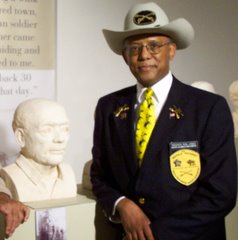
Note: Slight edits were made to the article to update certain time lines. The photo of Trooper Wedlock was made available by the Vermont Area 9th & 10th (Horse) Cavalry Association. Vermont-Buffalo-Soldiers - Fort Ethan Allen